



 0
0

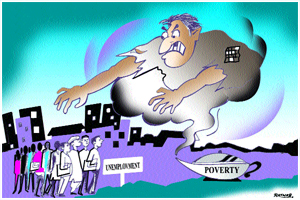 Poverty is spreading its tentacles, far and wide, in urban and rural areas of Sindh, as acute water shortage has hit hard the agriculture. The industrial production too, is going down and unemployment has risen to an alarming level.
The recent State Bank of Pakistan quarterly report for July- September this year, reveals the national industrial production growth is 5.3 per cent. It is not even 0.1 per cent in Sindh.
An official survey of 30 selected large scale categories of industry covering 465 industrial establishments in Sindh precisely calculate industrial production growth at 0.08 per cent during July to September this year.
Officials say that employment in the industrial sector during first quarter of 01-02 is about three per cent less than what was estimated in the same period of last fiscal year. Figures show that total employment in 30 categories of the industrial sector, covering 465 industrial establishments is not even 100,000 workers.
The scene is far worse in rural areas where one observes vulgar affluence of few “wadera families” and unbelievable poverty among the peasants. A disturbance in schedule of release of irrigation water from Punjab in kharif and now in rabi has put off large number of peasants from their normal activities.
Big waderas have laid off the peasants engaged on crop-sharing basis. Farmers with small holdings are unable to get their share of water. Credit availability is a costly affair for them. So what to do. Beg in cities or rob the people on highways.
In Karachi and Hyderabad more than 1.5 million young men and women, mostly educated and technicians are in the job market.
More than two million are said to be sitting idle in the countryside, where harvesting a bumper or a meagre size crop of cotton, sugarcane and rice are problem for the peasants. Filthy rich waderas in connivance with the ginners, spinners, sugar millers and ‘arhtis’ rob the peasants of due price of their produce.
No wonder, Karachi is now swarmed with beggars. Crime is on rise. More than 900 vehicles were snatched in the month of November only and this number is showing increasing trend in December.
Mugging, burglaries and hold-ups are neither being reported accurately in the media nor the law enforcing agencies (police and rangers) bother to take any steps to put a check. industries minister, an industrialist himself, works overtime to expand his business empire.
The Sindh agricultural minister is a turncoat, a Pakistan Peoples Party deserter, who in private conversation uses harsh words against the excesses of the federal government but prefers to hang his head down when asked to offer on record comments.
None of these Sindh government team member responded to the revenue data released by the Central Board of Revenue.
This data conveys a lot of information and demands attention of the government. For example the property tax collection in Lahore has been Rs 1.30 billion. But in Karachi the government could collect only Rs 348 million.
The questions are why and how. Has the number of property units in Karachi gone down or shifted to Lahore?
Only recently, just before the announcement of the current fiscal year’s budget, the Sindh government launched a new system of property tax with a claim that it would increase the revenue. What has happened.
Stamp duty collection in Lahore is reported to be Rs 800 million as against Rs 471 million in Karachi. Motor vehicle tax collection in Lahore was Rs 399 million but Rs 296 million in Karachi.
Other information pertains to current and development expenditure incurred in these cities and federal transfers besides break up of various federal and provincial taxes. “The citizens are now able to compare the tax collected from these cities and expenditures made and the quality of these spendings impacting their lives” is the purpose.
But the punch line is the revenue collected from Lahore is much higher than that from Karachi contrary to what is commonly believed by the people.






























