0
0

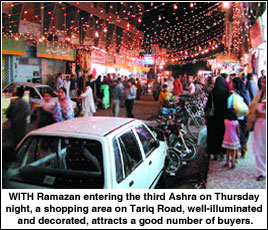 KARACHI, Dec 6: Glittering lights in and outside the shopping centres, overcrowded roads and side lanes, and heavy rush in cloth, garments, shoes and cosmetics shops is now a common scene in the city after 9pm as Eid shopping is in full swing.
People usually wait for the passing of 10 initial nights of Ramazan and then begin shopping, which lasts till the Eid night.
All the shopping centres have now started their late night sittings after the passage of first Ashra (ten-days) of Ramazan.
The shopkeepers and consumers usually complete their five, seven or ten days of Taraveeh programmes at specially arranged places or in mosques and then start their Eid selling or shopping business.
Despite economic strain being felt by the country because of the war on Afghanistan and growing price hike, there is no decline in Eid shopping in the city as rush at the major shopping centres is the proof of this impression.
Just drive or walk down to Tariq Road, Saddar’s Bohri Bazar or Zaibunnisa Street, Gulf Shopping Mall in Clifton, Jamia Cloth Market and Motandas Market at M.A. Jinnah Road, Super Market in Liaqatabad, Hydery Market in North Nazimabad and innumerable places in the city, the shops start getting rush of men, women and children after 9pm, which usually last till late night.
The city administration, with other concerned departments and traffic police in collaboration with shopkeepers association have also started setting up special complaint centres at the major shopping centres in the city to register complaints about price hike or any theft or pick-pocketing.
Official sources confirmed that over 30 such camps have been set up at various shopping areas in different parts of the city, which are managed by Sindh Bureau of Supplies and Prices in collaboration with City Government, Police and other agencies.
At some shopping areas, associations of shop-keepers have set up similar camps for the benefit of people. Some shopping plazas in posh localities of Defence, Clifton and Tariq Road have arranged their separate security system.
According to a survey of various shopping areas of the city by APP during the last couple of nights, there was an unusual rush of buyers at major shopping centres.
Shopkeepers said shopping for Eid items would go up further as Eid would come nearer. Even now in some areas, there is more shopping than usual.
“I think this year buying trend is normal and there is no decline in it,” said Qasim, a cloth merchant in Saddar.
He said people waited for the entire year for Eid, so they have to buy at least essential items for their families.
Children’s items are in a great demand, because every family, whatever is its economic position, prefers to buy something for their young ones.
During the initial days of Ramazan, there is rush in cloth shops and at tailors’, but as the Eid approaches, people start buying readymade clothes at garment shops or boutiques, shoes, bangles and cosmetics.
For the women shopping is a hobby, so their buying spree continues into Eid night. Every other night they visit these shopping centres — sometimes for buying similar things and making changes of sizes or colours. The Chaand Raat is spared for purchasing bangles and applying Mehndi (Henna).
Special stalls come up for this purpose one or two nights before the Eid.
Anwar Mohibullah, a shopkeeper at a shopping centre in Clifton said it was a trend in our society that people usually shop more during Ramazan for Eid-ul-Fitr because this is the only occasion which is traditionally celebrated by Muslims with fervour.
This year, the improved law and order situation has also reinforced the shopping spree.
A trader at Bohri Bazar in Saddar said the opening of Eid and Bachat Bazars in almost every nook and corner of the city was a proof that this year Eid shopping was more than usual.
But the mushroom growth of Bachat Bazars has caused concern among the shopkeepers in the organized shopping centres. Shopkeepers said these informal bazars, set up without any additional overhead expenses, are affecting their business.
These bazars, which have been allowed by various civic agencies including Town administrations, have not only caused concern among owners of the shopping centres, but also caused worries to tax authorities and government officials.
“The stalls at these bazars do not pay anything towards taxes, which may be collected if the shopping is made through registered shops,” said an official at Sindh Bureau of Supply and Prices.
He said the Bureau was already running 39 weekly bachat bazars in different parts of the city, which provided items of daily use at controlled rates.—APP