0
0

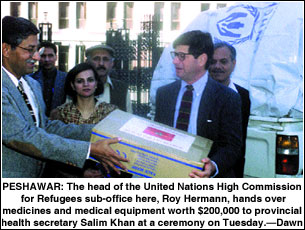 PESHAWAR, Dec 4: The NWFP health department spends about Rs336.485 million on the healthcare of Afghan refugees in four tertiary hospitals of the province every year.
Besides, Rs94.109 million (33.72 per cent of the total budget of government-run hospitals) is spent on the refugees in 14 out of 23 districts of the province.
Health Secretary Mohammad Saleem Khan said this, while briefing newsmen here on Tuesday after United Nations High Commission for Refugees (UNHCR) handed over medicines worth $200,000 to the health department for the refugees.
The secretary received the medicines, donated by Bangladesh and Morocco, from the UNHCR’s Peshawar office head, Roy Herman.
The secretary said that like other sectors, the refugees were also badly affecting the health sector.
According to a survey, only the Hayatabad Medical Complex was receiving between 48 and 53 per cent of the refugees daily while between 29 and 37 per cent refugees visit district and agency headquarters hospitals.
The federal ministry of state and frontier region (SAFRON) is providing Rs30 million for three major hospitals of the province — the Hayatabad Medical Complex, the Khyber Teaching Hospital and the Lady Reading Hospital, Peshawar — for looking after the refugees.
Replying to a question, Mr Khan said the district and agency headquarter hospitals required equipment, besides medicines, to meet requirements of the local population as well as the refugees.
Various relief agencies were providing assistance to the health department and the DFID had already committed one million pounds for the supply of drugs, he said and added that the World Health Organization had provided the department with seven emergency kits and also promised to provide two ambulances for Fata.
The UNHCR has provided medicines worth Rs1.5 million through the project directorate health, Afghan commissionerate, to six high-risk hospitals in the tribal areas.
The Bangladesh government recently donated anti-biotics, anti-histamine, anti-fungal, oral re-hydration salt, antacids, intravenous infusions while the Republic of Morocco donated two tonnes of assorted drugs, medical supplies and surgical materials.