



 0
0

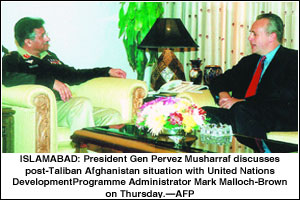 ISLAMABAD, Nov 29: A three-day “Conference on Preparing for Afghanistan’s Reconstruction” ended here on Thursday with a pledge that no development and rehabilitation work will be carried out in Afghanistan in the absence of any broad-based government there.
“The setting up of a broad-based government is a mega conditionality to start any reconstruction work in Afghanistan,” said Mr Mark Malloch-Brown, the Chief Coordinator of United Nations Development Programme (UNDP).
Speaking at a joint news conference with World Bank Vice-President for South Asian Region Ms Mieko Nishimizu and other senior officials of the Asian Development Bank and UNDP, he said that without broad-based government, there will be no financial and technical support by the international donor agencies.
However, the conference could not come up with any assessment about the funding requirements as was earlier being anticipated. “We are not here to give you any number. This is not the time to put a price tag. We are still assessing everything and may be things are finalised at the third such conference to be held in Tokyo early next month,” replied Ms Mieko when asked about the size of the reconstruction programme for Afghanistan.
Answering a question Mr Brown said that peace and security was necessary to undertake any meaningful rehabilitation work in Afghanistan. He expressed the hope that the Bonn conference will succeed in having a broad-based interim government in order to carry forward the much-needed development programme in that country.
He, nevertheless, said that it will be a five-year reconstruction programme which was most likely to be taken up early next year. “But it may not be very easy if there is no peace and if there is no ownership of the reconstruction programme,” he added.
Mr Brown also said that events were changing very fast in Afghanistan. “Taliban and al-Qaeda now seem to be a temporary matter and we all should make sure that Afghanistan does not become a failed state,” he added. The development of agriculture and provision of health and education will be the important tasks of the donor agencies in Afghanistan, he said.
“Half of the population in that country carries weapons and we will have to make sure that they abandon their arms,” Mr Mark said, adding that 50 per cent forgotten population of women will have to be given lot of importance in the reconstruction programme.
In reply to a question, he said the role of all the neighbouring countries of Afghanistan had been a “negative” one and then hastened to add: “But they all are today wanting a strong and functional Afghanistan”.
He said that next week another conference on Afghanistan will be held in Berlin. This conference, he pointed out, will be a meeting of Afghan Support Group to further discuss reconstruction process for Afghanistan.
Asked how would the donors’ mission of reconstructing Afghanistan be possible if there was no multinational force there, he said this was a serious issue and needed to be settled by the Bonn conference.
At the end of the conference, “Co-chair’s concluding remarks”, signed by Ms Mieko Nishimizu (World Bank), Mr Yoshihiro Iwasaki (Asian Development Bank) and Mr David Lockwood (UNDP) were also released to the press.
“We need to avoid quick fixes and the tendency to set up inappropriate and costly precedents that would be difficult to fix later on — however expedient they may seem. Putting in place good economic policies and building sound economic institutions at the outset is important including a central monetary authority, fiscal system and functional financial and payment system,” the concluding remarks said.
It further stated that security was essential for the reconstruction effort — encompassing political stability, law and order, legal and financial planning. “In particular, de-mining will be an important immediate priority,” it said.



























