



 0
0

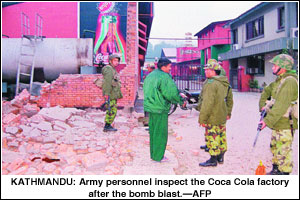 KATHMANDU, Nov 29: Maoists on Thursday bombed a Coca-Cola factory on the outskirts of Kathmandu in their first attack on the capital since Nepal’s government declared a state of emergency this week.
The Maoists planted two bombs at the site, causing some damage to the factory. None was killed nor injured, officials said.
N.N. Singh, the manager of the plant at the Baluju Industrial Estate, said six armed Maoists planted the pipebombs after threatening to kill the factory’s night guards.
The rebels told the six guards that “if they made any noise they would be killed, so the guards could not do anything”.
“Then one of them entered the bottle cleaning plant while others started laying other explosives at two or three places, but only two bombs exploded,” Singh said.
He added that engineers were assessing the extent of damage “but the explosion was very powerful and blew off the roof of the factory”.
After planting the bombs the Maoists fled from the scene, the management said.
At least five of them, who were carrying guns and explosives, were arrested at a bus terminal nearby, said Devendra Raj Kandel, the state minister for home affairs.
Analysts said the attack on the US beverage giant was likely meant as a signal to the United States, which has strongly backed the Nepalese government’s crackdown since the Maoists broke a four-month ceasefire a week ago.
In Washington, State Department spokesman Richard Boucher said on Wednesday: “We’ve said we clearly support the Nepali government’s efforts to protect its citizens and officials. We are in close touch with the Nepalese government about this.
“We’ve clearly condemned these attacks, we’ve called on the Maoists to pursue any goals they might have peacefully within the Nepalese constitution.”
Some 350 people have been killed in seven days of fighting between the government and the Maoists, who want to abolish the constitutional monarchy and set up a socialist state.
India has told Nepal it is ready to offer it “whatever assistance was required”. The Kathmandu government has said it is seeking arms, ammunition and helicopters from India or other “friendly countries” to crush the Maoist uprising.
Bikram Bahadur Grung, who lives near the Coca-Cola plant, said residents were early on Thursday “rudely awakened by a very loud explosion”.
“Our concrete buildings were shaken as if there was an earthquake,” he said.
A police guard near the factory said the blasts went off at 5:10 and 5:15 am (2325 and 2330 GMT on Wednesday).
Prime Minister Sher Bahadur Deuba reassured business leaders that Nepal was committed “to the security of industries and their peaceful operation” and was “working hard to improve the environment to encourage foreign investment”.
Speaking to the Nepal-China Non-Governmental Cooperation Forum, he said the state of emergency declared on Monday was a “temporary phenomenon”.
Ravi Bhakta Shrestha, president of the Federation of the Nepalese Chamber of Commerce and Industry, condemned the “anti-American” attack, which he said would hurt Nepal.
“The bomb attacks on the multinational Coca-Cola industry in the outskirts of the Nepalese capital will spread a negative message against Nepal at a time when we are facing a dearth of foreign investment in the industrial sector,” Shrestha said.
Nepal’s major money-maker, tourism, has been badly hurt since the June 1 massacre of 10 members of the royal family and a subsequent surge in Maoist violence.
The government and the Maoists reached a ceasefire in July, but three rounds of peace talks yielded little progress.
Coca-Cola has two plants in Nepal, one near Kathmandu and the other in the lowland region of Parsa, 180 kms south of the capital.
The Kathmandu-area plant, which was established in 1979, employs 400 Nepalese workers and indirectly supports 20,000 jobs, the factory management said.
The Atlanta-based beverage giant has invested nearly two billion rupees (26.31 million dollars) in the factory.—AFP



























