0
0

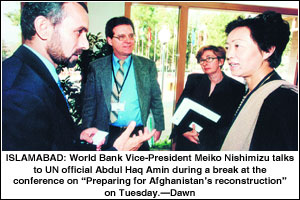 ISLAMABAD, Nov 27: A 3-day conference on “Preparing for Afghanistan’s Reconstruction”, which began here on Tuesday, called for early setting up of a broad-based interim government in Afghanistan so that development and reconstruction work in that war-ravaged country could be undertaken.
Speakers from the United Nations, World Bank and Asian Development Bank, though extensively talked about the much-needed rehabilitation and reconstruction work in Afghanistan, they did not give any funding estimate nor pledged any assistance programme, at least during the inaugural session.
Ms Meiko Nishimizu, World Bank Vice President for South Asian Region, told over 200 participants, including Afghans, that reconstruction of Afghanistan was required to have an early economic, social and political transformation there.
Time has come when Afghans should be allowed to shape their destinies independently, she said and expressed the hope that political resolution of the problem, now being tried in Bonn, Germany, will bear fruits.
Poverty reduction and economic growth, she pointed out, were largely required in Afghanistan for which a joint strategy was being worked out. However, she did not mention any proposed funding to be offered by the World Bank for the rehabilitation and reconstruction work.
Conflicting financial estimates were being quoted by donor and private agencies for the reconstruction of Afghanistan. First, it was said that it will require $6 to $8 billion during the next ten year period. Then the figure of $10 billion was also quoted, and some of the newspapers claimed on Tuesday that reconstruction work will cost $20 billion.
“The agenda of three-day gathering here is very critical,” Ms Meiko said, adding that events of Sept 11 posed threat to world peace and security.
“Without humble and tolerant leadership in Afghanistan, no participatory process could succeed in that country,” she warned.
A number of important speakers who talked about the rehabilitation of Afghanistan termed the next four months “very crucial” and “significant.” Nevertheless, none of them mentioned the ongoing military action and bombing at various places.
“How can you have any reconstruction when military action is going on in Afghanistan,” asked a participant sitting close to media enclosure. “They will have to first give up hypocrisy to do any meaningful rehabilitation work in that highly poor and battered country,” he said.
ADB representative Yoshihrio Lwasaki said his bank was ready to provide all necessary financial support for the rehabilitation and reconstruction of Afghanistan. “We are meeting here at a time of great anxiety,” he said, adding that Afghanistan needed the rehabilitation of its agriculture, education, health and hydel power systems urgently.
He said there had been a sharp deterioration in the fiscal systems of almost every country following the Sept 11 events. “World economy has slowed down as there has been a profound impact of the terror blitz on the economies of every country,” he remarked.
The ADB has set up a special task force to work out new recommendations for helping the affected economies of this region, he said. But the people of Afghanistan need sustained support, he hastened to add.
He said that political settlement will help in undertaking a speedy rehabilitation. “And the ADB is ready to play a key role in that effort.”
The prospects of peace in Afghanistan have brightened as efforts are being made in Germany to have an early interim government installed, UNDP representative David Lockwood said. He was sanguine that the political process undertaken by UN senior official Lakhdar Brahmi would bear fruit.
“We should look from the eyes of Afghanistan and its people and should not look for new business opportunities there,” he said.
One of the important tasks, he said, was to ensure funding for civil servants and police to have rule of law in Afghanistan. He said thousands of talented Afghans who left their country many years ago could greatly contribute to the reconstruction process.
He said there will be another important conference in Japan in the second half of January which will be again participated by the World Bank, UNDP and ADB to have further assessment of the needs of that country.
Mr Karl Fischer of United Nations Special Mission in Afghanistan said the new Kabul dispensation will have to have internal and external legitimacy. It will have to make sure that Afghanistan did not become a place for terrorism and drugs, he added.
He was hopeful that all the four groups involved in the Bonn talks will come to terms to have peace and stability in Afghanistan. “But I believe another group of women should also get representation in the peace process”.
Mr Fischer also said that a number of Afghan groups were calling for multinational forces to be the part of the interim government. “But unless there is a surety that there will be no outside interference, nothing will happen,” he said, adding that the political process was essential for reconstruction. There was a need to have a legitimate government in Afghanistan which should also be accountable for its deeds, he added.
“There are pitfalls ahead and the assistance agencies should not take those decisions which ought to be taken by Afghans themselves,” he said. The crisis in Afghanistan will be a constant threat to other parts of the world.
Mr Mike Sackett, the UN Coordinator, gave an update on humanitarian situation in Afghanistan, pointing out that there was a requirement of 52 thousand tons of food supplies. The World Food Programme could so far manage only 52 tons of food deliveries into Afghanistan, he maintained.
In addition, there was a need to send tents, blankets, medicines and other necessary items there, he said, adding anti-polio programme was also needed, especially in Bamyan province.
He said that the UN had appealed for collecting 664 million dollar for Afghanistan but so far only 43 per cent of that amount had been managed.
Mr Sultan Aziz, another UN official, said he himself was an Afghan and believed that there was an urgent requirement of capacity building in his country. The process of reconstruction, he believed, will be undertaken by the donor agencies in a big way.