



 0
0

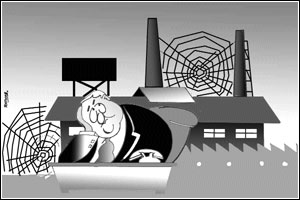 THE sponsors of most of the engineering units are now well educated and they can assess the pros and cons of any expansion in capacity.
Therefore, the bankers may have some comfort on this account. Expansion of the existing capacity is normally less risky than financing the establishing of a grass root new project. The potential creditors to the engineering units may utilize the usual guidelines for assessing the viability and debt servicing capability of the proposed projects subject, however, to assessment of the additional risks to which the engineering units are exposed. Some of these risk areas are briefly discussed in this article.
The deletion policy of different products of engineering industry formulated in 1980 was further reviewed in 1995 and is under implementation with higher degree of transparency. The Industry Specific Deletion Programme (ISDP) for progressive manufacture of deep freezers, motorcycles, and tractors was prepared during 1998-99 and the CBR had asked for implementation accordingly. The deletion has attracted investment in many joint ventures and technical collaboration for local manufacturing in the country. The overall deletion achieved for certain products is nearly 80 per cent whereas for others the deletion ranges between 60 and 70 per cent.
Local engineering industries and vendors are worried of the post-WTO scenario, particularly provisions of the agreements pertaining to the Trade Related Investment Measures (TRIMS) and Trade Related Intellectual Property Rights (TRIPS). In the context of deletion, they would be seeking exemption up to 2005. It appears they may not get it from the WTO . In such a scenario, the government may have to remove the preferences in the import duty allowed to the local engineering industries operating under the deletion regime. Thus the engineering industries shall have to take urgent remedial measures particularly to improve efficiency and management practices. In view of the present day conditions and the impact of the WTO agreements, it is felt that the capital goods manufacturing sector might suffer a serious setback.
The mechanization of agriculture plays an important role in increasing agriculture production and for reducing pre- and post-harvest losses. For induction of latest technology in the agriculture production system, the government is planning to introduce corporate farming so that the required level of efficiency can be brought about in the system. As a first step, an SRO (I)/2001 allowing import of agriculture machinery (not locally manufactured) at 10 per cent custom duty ad-valorem has been issued so that large-scale agriculture modernization be introduced in the country. Efforts are underway to increase tractor population in the country. The tractors market is substantially dependent on fresh loans for purchase of tractors from the Agriculture Development Bank of Pakistan (ADBP). In case the bank does not advance loans, it will be difficult for tractor manufacturers to plan production properly or to sell all their output.
The automobile industry is said to enjoy the status of the most protected industry in Pakistan where the effective protection rate (EPR) is said to be rather very high. The local car assemblers are fighting for the share of the market through non-price factors like advertisement and alliance with leasing companies. Against the national demand for 100,000 cars, the local car industry has never produced more than 40000 cars. The automobile sector needs deregulation and curbs on smuggling. The protection to the automobile industry may not remain so high in the coming years due to the WTO factor. Auto engineering industry should better adjust to the impending situation at the earliest.
The problem of sick units has confronted industrial activity for quite some years. The sick units whose default cases have been taken for adjudication by the creditor banks and DFIs over the last few years are 868 in number and total unpaid loans are of Rs107 billion. The government has established the Corporate and the Industrial Restructuring Corporation (CIRC) to tackle the long-standing problem of sick industrial units and to overcome financial difficulties of the NCBs and the DFIs. The revival of sick industrial units is expected to add to the productive capacity, revive industrial activity and increase employment opportunities in the country. The list of sick units includes a number of engineering units as well. In fact, some of the engineering units are already on the liquidation list. The loss of engineering capability and technology might in a sense be a big loss to the country.
Public sector industries: The government had launched an ambitious privatization programme in 1991 in order to minimize its role in industrial and commercial activities. Successive governments accorded high priority to the privatization process for restructuring and re-vitalizing the national economy. So far 103 units have been privatized besides partial divesture of the PIA and the PTCL. The process of privatization has bogged down in legal, procedural and administrative snags since 1994. The present government, which has taken several measures to implement the privatization programme speedily and judiciously, is committed to privatization of sizable assets in the telecommunication, banking, oil and gas, power and industrial sectors.
Privatization in the past in some cases did not fully protect the interest of the existing lenders. Possession of the privatized units was handed over to the new owners, without consent of the lenders who had charge on all project assets. As the new owners have no documentation with the existing creditors, they do not appear inclined to settle the dues in a decent manner. The privatization process has to be more balanced.
The Pakistan Steel is providing basic raw material to a large number of local high-tech engineering industries in the country. The main products of Pakistan Steel are coke, pig iron, billets, hot rolled coils/sheets, galvanized sheets, etc.The Pakistan Steel has established 34 downstream industries in the private sector for optimum utilization of its production capacity. A large number of engineering units including those located in the PS Industrial Estate, for successful operations,they need regular availability of raw material in agreed quantity and at agreed price. Any adverse action by the Pakistan Steel or disruption in supply of raw material will jeopardize the profitability of the engineering units.
The rules of the Industrial Estate in Pakistan Steel and in the Hub Chowki Industrial Estate at one time were such that the charge in favour of the lender banks and DFIs could not be registered in the early stages of implementation when the loans were to be released for the purpose of the project. Until the mortgage was registered the lenders were at greater risk, for the covering of which some other collaterals are sought from the sponsors. The lenders should take precautions of such risky situations at the time of project appraisal.
All specialized units are also dependent on general engineering orders to get some work for thier labour force, which otherwise would become idle due to absence of orders in the specialized field for which the units have been designed and planned.They have to work against many odds and have to accept orders on the principle of recovery of variable cost. The capability of each engineering unit to generate revenues through such activities may also be assessed at the time of appraisal.
Financing of engineering industries is relatively more complicated than traditional industries such as spinning, sugar or cement. Engineering industries producing capital goods have a totally different market than the engineering units producing consumer durables or the units producing automobiles. Moreover, applicable government policies including import duties may also be different. Therefore each financing for the engineering industry has to be appraised differently, keeping in view the particular sub-sector and the environment in which that particular industrial unit is operating. The financing modes to be used and the precautions to be taken in each case shall have to be tailored to each particular sub-sector or industry.
Raising of funds at competitive cost and with minimal restrictions or conditions is the need of every engineering unit. One may not achieve the target fully but one should at least make an attempt for that. The project sponsors should carefully evaluate the financiers in the field and then pick the ones, which best meet their needs on timely basis. Also they should realize that in the present difficult times, some modes of finance might have better chances of success than the other modes. The financing situation at present is briefly described below:
The country is passing through a difficult and uncertain period. The stock exchanges are not showing much activity. People appear to generally have lost appetite for new share or the TFC issues at the moment. For the local engineering industry in general it will be rather difficult to raise short term or long-term resources through the stock exchanges. However, the engineering or auto/allied industries quoted on the Karachi Stock Exchange above par, may succeed in raising moderate fresh resources through issue of right shares.
The NDFC has been, effective November 1, 2001, merged with the NBP. The BEL is under liquidation. The PICIC and the IDBP are without any foreign currency line or foreign resources for financing medium and large industries. The three joint venture DFIs are there but these have not been significant players in project financing. The fourth JV DFI is under formation, but it is also expected to follow the policy of existing JV DFIs. The DFIs appear to be less inclined to finance projects at present. The PICIC and Saudi-Pak have entered the leasing sector and are expected to offer tough competition to leasing companies, particularly those which do not belong to established business groups with secure credit lines.
The HBL and the UBL once provided project finance. Both have collected large bad loans. They are expected to play safe and may avoid risky propositions. The field is more or less wide open to the international banks operating in Pakistan. If they find an attractive proposition from their point of view, they are expected to arrange foreign funds from outside Pakistan. Presently.the WAPDA and the KESC are in financial difficulties. The NCBs are largely coming to the rescue by providing large loans to these utilities. The government reportedly guarantees these loans. Public sector engineering units may expect financing facilities from the commercial banks but against government repayment guarantees. The NCBs and the foreign banks may be willing to roll over existing short-term facilities on selective basis. The small and medium enterprises (SMEs) constitute 90 per cent of businesses in Pakistan, mostly in services and manufacturing. The SMEs play critical role by providing 80 per cent of the industrial employment, contributing 30 percent to the GDP and generating one-fourth of the sector’s export earnings. Realizing the constraint of credit facility to the SMEs, the government has opened micro-credit bank, has reorganized / expanded the role of SBFC into a bank for the SMEs and also set up the SMEDA for providing assistance. These facilities will be particularly suitable for engineering workshops.
The leasing companies and modarabas are already working with the auto manufacturing and vehicles are being leased out. Other consumer durables may also be added to the list if the respective industrial units pursue the matter with the financiers.
The World Bank is not favouring new capacity in Pakistan in many sectors. Until this policy continues, no fresh credit line is expected for the purpose. However, the International Finance Corporation may be inclined to consider financing certain attractive projects.
Foreign machinery suppliers may be willing to provide finance for new capacity or expansion. However, they will require repayment guarantee from banks acceptable to them. This will be rather difficult in the present day scenario. However, the engineering industries that are part of multinational companies can also raise resources through assistance of the parent groups.
Developed engineering industries with appropriate technologies are critical for the revival of our economy. Pakistan has to revive the engineering units which have the potential for competition, are properly managed and are without any overstaffing. The report being prepared through the SMEDA may help in this endeavour but may not be enough. Much more needs to be done. The government might have to take all stakeholders including the financiers into confidence in this important task. Rescue package in any way is not to violate the WTO agreements, yet it must provide enough support to the engineering industries to let them survive in the new environment.
Industry Deletion %
1. Electrical
Transformers 100%
2. Electric pumps 95%
3. Electric motors 100%
4. Tractors 82%
5. Electricity meters 85%
6. Deep Freezers 86%
7. Trucks and buses 58%
8. Refrigerators 84%
9. Electric Iron 74%
10. Motorcycles 72%
11. Window type
Air-conditioned 76%
12. Fruit Juice extractor 81%
13. Sugar Plants 79%
14. Motor Vehicles 64%
Source: Economic Survey 1999-2000.






























