



 0
0

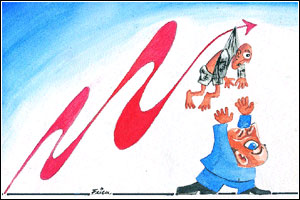 THE global fight against terrorism has given a sense of urgency to the rich countries to combat absolute poverty as that is now recognised as eventually breeding terrorism; but when the Group of 20 states met last week in Ottawa there was no agreement on how to combat poverty or help the very poor countries.
The millennium session of the UN General Assembly fixed 2015 as the deadline for reducing poverty in the world by a half, but now there is the fear that even this distant goal of halving the poverty of 1.5 billion people of the world, may not be reached unless resolute steps are taken from now on. In fact, there is the fear that during this period more people in the developing countries may become poorer following current developments, like the global recession which hits the developing countries harder and made far more unemployed or suffer lower wages.
There was resounding theatric at the top on the urgency for combating poverty and helping the poor countries in Ottawa, including the chiefs of the World Bank and the International Monetary Fund. That happened despite the fact that demonstrations against the tardy policies of the rich countries and the World Bank and the IMF were smaller than at other meetings of finance ministers and central bank governors at other places from Seattle to Genoa last, but the need for trying hard to reduce global poverty was underscored by many leaders, though the end-result was no consensus on how to do that effectively. Sentiments have to be followed by solid action.
The IMF Managing Director, Horst Kohler, said there: “There is a major problem in the fight against poverty and that is the selfishness of the advanced countries.”
And the British chancellor of Exchequer, Gordon Brown, who is the chairman of the policy - setting committee of the IMF, said the terrorist attacks of September 11 “have given the world’s richest nations compelling reasons to abolish all forms of human poverty.”
Speaking to the Federal Reserve Bank in New York he urged the world leaders today to take over the mantle of the post-war generation, which built a new world order around new institutions then like the UN,the World Bank and the IMF and banish poverty. He called for a doubling of the international aid from 53 billion dollars to 100 billion annually upto the year 2015. He wants a new financial architecture in which the governments and the private business could help the developing countries out of dire poverty.
He warned the Western world that “what happens to the poorest citizen in the poorest country can directly affect the richest citizens in the richest country.” He said the forces of globalization and free trade had to be harnessed to bring prosperity to the developing world.
And the president of the World Bank James Wolfensohn, who has been advocating the cause of the poor strongly in recent years, came up with a four-point formula to help the developing countries in which their governments too had to play their part. He also urged the level of international assistance to the developing countries to be raised to 100 billion dollars a doubling of the aid from the present low level.
And Wolfensohn immediately wants the rich states to contribute generously to the 13th replenishment of the funds of the IDA (International Development Association) a soft window facility of the World Bank which helps the poor countries. Its pending session is to be held in Switzerland early next month.
But a heated new controversy has arisen over the use of those $13 billion funds. The US now wants 50 per cent of the soft loans advanced by the IDA to be made non-refundable grants. The European countries are opposed to that. And they hold 40 per cent of the voting power in IDA. While the US holds 20 per cent and Japan 18 per cent of the votes.
The very vocal development secretary of Britain, Clare Short, holds that as a crazy idea and a very bad idea. She intends to rally the European nations against such moves as that will curtail the cash flow of the World Bank.
President George Bush supports the move to treat half the aid funds of the IDA to the poor countries as grants and has authorised his treasury secretary, Paul O Neil, to pursue that goal. And O’ Neil says that with his call for more money instead of loans the President is calling on the world to be honest about these things.
The US Administration believes that the World Bank should give money as grants instead of loans because most poor countries are already saddled with unmanageable mountains of debt, which means the new loans are not likely to be repaid. Says the treasury secretary. Total external debt of Argentina is $132 billion, down from $140 billion recently.
Some countries like France would like to see restricted grants which should be around 10 per cent of the IDA loans. France’s Finance Minister Laurent Fabius wants the private sector banks and major bond-holders to play large role in resolving the financial crisis.
And Canada wants IDA loans to be on even softer terms which includes partial write-off of loans.
The realization is there among the donors that many of the heavily indebted countries will not be able to repay their huge debt — not only the least developed and most indebted countries of Africa and Latin America which have been helped with partial write-off of the loans. The fact is that along with the need to repay the external loans they are also forced by the IMF or others to devalue their currencies heavily. And that multiplies the debt burden such countries have first to mobilise their repayable funds in local currency and then convert it into dollars. Pakistan, for example, has to repay at Rs 61 to a dollar, loans received at Rs 5 to Rs 9 to a dollar, and that makes the repayment too exasperating, including finding the foreign exchange to service the loans.
Quite often the heavily indebted countries largely recycle their foreign loans. What comes as new aid is used to repay or service the old debt. The aid recipients are not gainers for that, despite the large new aid.
After some years this cycle is also broken, as in he case of Pakistan, and the debtors ask for re-scheduling the loan repayments. And then a second and third re-scheduling follows, with Pakistan providing a very glaring example.
In addition such debtors have also very large domestic debt with high interest rates. In the case of Pakistan, interest payments on domestic loans are a high Rs175 billion. Internal debt is equal to 50 per cent of the GDP.
While Gordon Brown and Wolfensohn are calling for a doubling of the external aid to $100 billion a year until 2015 to achieve the goal of halving poverty in the world by then the fact is the aid given by the rich countries has plummeted to 0.22 per cent of the GNP of the rich countries, with the US below 0.2 per cent in spite of its phenomenal economic growth in the 1990s and large eventual budget surpluses. All that is way below the 0.7 per cent target set for the aid by the UN after the original one per cent of the GDP was dropped. Countries like Norway and other Scandinavian states and the Netherlands give around one per cent of their GDP while the US gives a small fraction of that. So even if foreign aid is doubled now, as urged by Britain and Woldensohn, the total will be only 0.4 per cent of their GDP against the 0.7 per cent target.
Wolfensohn’s four-point formula calls for better policies and governance in developing countries, reduction of trade barriers and making the next round of negotiations of the WTO a real development round motivated primarily by the determination to make trade an effective engine for poverty reduction and development. He wants increase in foreign aid and the nations to act internationally on global issues.
And the IMF chief wants large contributions for his poverty reduction programme. Nine countries have only contributed to that with Japan leading with one billion dollars. What happens in this area in the next few months is very important. What matters is matching the deeds or money with the recounting words.
This global debate about how to help the poor countries, and reduce poverty breeding civil wars and terrorism, is taking place at a time when the US is debating the size and scope of its economic stimulus package. While the Democrats want a 75 billion dollar package to help the unemployed, low income groups and those without social security cover, the Republicans want a 100 billion dollar package for largely giving tax relief to the US citizens and promote demand to spur the economy.
Gordon Brown tells the West: “Not only do we have inescapable obligations beyond our front doors and garden gates, responsibility beyond the city hall and duties beyond our national boundaries, but also this generation has it in our power — if it so chooses — to abolish all forms of poverty.”
The question is: will the West, particularly the richer among them, rise to the occasion and help the poor countries substantially to make globalization really meaningful or largely leave them to their fate with soothing words and small loans?






























