0
0

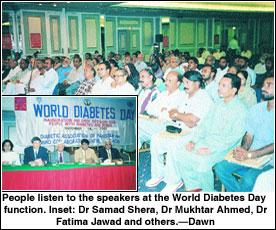 KARACHI, Nov 14: Terming diabetes a multi-disciplinary disease, capable of affecting all body organs and systems, speakers at a scientific session, held to mark the World Diabetes Day on Wednesday, suggested that specialists, general physicians (GPs) and other professionals and organizations should work together towards stemming the rising incidence of diabetes in the country, especially when there is scarcely any government effort towards the solution to this problem.
The event, organized at a local hotel by the Diabetic Association of Pakistan which is also the WHO collaborating Centre for Karachi, comprised two segments: scientific sessions in the morning and an open session for people with diabetes in the evening.
At the event, emphasis was also laid on creating awareness among the people about diabetes which had a direct relationship with an inactive lifestyle as a result of affluence.
In the opening session, WHO Collaborating Centre Director Prof A. Samad Shera, speaking on the subject of “Diabetes and cardiovascular disease — a time to act”, highlighted the large- scale morbidity associated with cardiovascular diseases in diabetics. He called obesity, smoking, over-eating, lifestyle ills and lack of physical activity important contributors in the onset of diabetes and cardiovascular diseases and stressed that a healthy modification in the lifestyle was important to ward off these problems.
A visiting expert from the UK, Dr Rehman Khan, spoke about the recent advances and trends in insulin therapy and also discussed various types of insulins and their appropriate dosage and use. He also mentioned Islet Cell Transplantation, latest technique for curing diabetes. In the Islet Cell transplantation, pancreatic cells were extracted from brain-dead donors and injected into diabetic patient’s pancreas. He said that patients undergoing this procedure were required to stay on immuno- suppressant therapy for the rest of their lives and expressed his reservation about the safety-profile of such long-term therapy.
Another visitor from Bradford, UK, Dr Jim Newmark, shared his experience in the provision of diabetes care to the Asian population. He said that among the Asian migrant population in Bradford, prevalence of diabetes was more than three times higher than in other migrant groups.
He added that the system for controlling type 2 diabetes in Bradford was very effective and hoped that this example might be emulated in Pakistan. According to him, health planners in Bradford, after realizing the importance of preventive and educational aspects of diabetes, are now placing greater emphasis on primary health care in which GPs have a greater role to play.
He said that satellite centres, comprising GPs, nurses and technicians trained in diabetes management, had been established throughout the area, to ensure that people had easy access to information and facilities on diabetes management.
Later in the evening, a panel of speakers at the open session highlighted the importance of a greater understanding of diabetes and its management among the patients and their relatives. They added that while genes played an important role in the onset of diabetes, inappropriate lifestyle was still the major culprit propelling the spread of diabetes.
Prof A. Samad Shera pointed out that nearly 55 per cent of diabetics were suffering from high blood pressure and are prone to heart attack and stroke, add agencies.
“A large number of international studies have proved that a good glycemic control reduces these risks by a large percentage,” he added.
Dr Rahman Khan discussed the process of taking insulin by inhalation which was still under trial but was expected to be marketed in the next two years.
“It will do away with daily pricks but as to how advantageous it would be is yet to be seen. The dose required will be seven times more than injectable insulin. It may be erratic in absorption from the lungs in case of a respiratory infection and it may produce lung fibrosis,” he explained.
Dr Jim Newmark, who has worked in the primary care sector in Risalpur and the NWFP for six years, observed that the Asians were the victims of lack of awareness.
SEMINAR: A seminar on “Problems and development in diabetes mellitus” will be held at the National Institute of Child Health auditorium on Thursday.