



 0
0

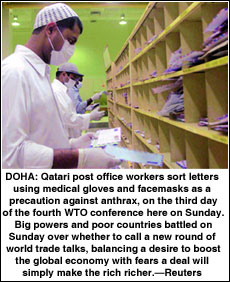 DOHA, Nov 11: WTO trade ministers got down Sunday to the nitty-gritty of negotiating a public health issue so emotionally charged it threatens the launch of new trade liberalisation programme.
India and Brazil are at the forefront of a pack of developing countries campaigning for a change to the World Trade Organisation’s patent protection agreement.
Faced with a public health crisis such as AIDS or other pandemics, they demand the power to override patents in favour of producing or importing cheaper copy-cat drugs, so-called generics.
“Availability and affordability of essential medicines is a universal human right. WTO should not deny that right,” India’s Minister of Commerce and Industry, Murasoli Maran, told a WTO conference here on Saturday.
Brazil has already found itself being hauled in front of the WTO’s dispute settlement body by the United States over Brasilia’s programme of providing anti-AIDS drugs free of charge.
The programme succeeded in cutting the death rate by 40 percent since 1997, but the United States complained it violated the WTO’s trade-related aspects of intellectual property rights accord (TRIPS).
It was finally settled in June when Washington withdrew its complaint.
The United States and Switzerland, both homes to some of the world’s biggest pharmaceutical companies, argue the current TRIPS accord is flexible enough to cope in a public health emergency.
They say patent protection is also crucial as an incentive for research and development into new medicines, an argument underscored by Harvey Bale, director general of the International Federation of Pharmaceutical Manufacturers’ Associations (IFPMA).
“One estimate that I have seen of the cost of drug development today is almost a billion dollars for a new compound to come to market and that is not an easy financial task to undertake,” he told a forum in Doha.
In addition, he stressed the importance of access not only to drugs but to “quality drugs”, saying that in Southeast Asia about 10 percent of products on pharmacy shelves were counterfeit.
“Patents are essential for access to drugs, without patents we would not have these drugs,” he said.
But the United States recently had a taste of its own medicine, negotiating hard with German drug giant Bayer for a discounted price on the anti-anthrax drug Cipro to help it deal with the anthrax crisis.
The agreement followed a warning by US Health and Human Services Secretary Tommy Thompson that the United States might waive the Germany company’s patent on Cipro to allow generics into the market if the two sides failed to strike a deal on a lower price.
WTO Director General Mike Moore has warned that the row over patents for drugs to fight major diseases could be the “deal-breaker” as ministers try to hammer out the agenda for a new trade round in the Qatari capital.
Going into the third day on Sunday, ministers grappled with the issue for the first time, with two draft options on the table representing the two camps’ positions.
Trade sources said countries had reaffirmed their stances, although US Trade Representative Robert Zoellick had indicated willingness to discuss changes of formulation in the draft if other nations were ready to do the same. Ellen t’Hoen, of Medecins sans Frontiers (MSF, Doctors without Borders), said although they were not against patents, a “one size fits all” system that only benefits part of the world was unacceptable.
“Society as a whole ... needs to benefit from this system,” she said, adding that pricing was only one factor in the equation.—AFP



























