0
0

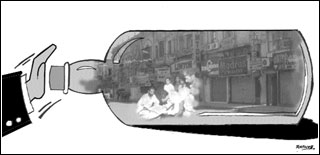 DO YOU recall the hullabaloo which surrounded the conduct of properties and business survey last year, and the way it was projected as the elixir for our sick economy?
It was supposed to be instrumental in contributing additional billions to the national exchequer, enabling the country to meet its “high and aggressive targets.” Like all quixotic plans, it was bound to fail, and it did. We are fond of conceiving grandiose schemes without taking into account the ground realities. This piece is an attempt to examine the realities which were ignored and/or soft-pedaled, and suggest a pragmatic approach to the issue.
Firstly, the CBR officials, much less the army personnel who were called to aid the former, neither had the expertise nor the logistic support to carry out the work assigned to them. Determining any realistic estimate of the production of one single factory or a turnover of a shop requires not only the expertise but also the hard work spanning over weeks, if not months. On both counts, the survey teams were sorely deficient. The task became far more difficult given the resistance posed by traders and industrialists.
Secondly, the tax department is just not geared up to utilize the information gathered in any meaningful way. The record-keeping in the tax departments is in a lamentable state. More often than not, a file is not traceable and invariably is incomplete. What use can be made of a heap of figures if they can not find their place in the appropriate files, presuming that the survey teams would succeed in collecting the information they were targeting? For almost 20 years, the tax department has been trying to computerize its various functions, without a whit of improvement. Unless we have developed the capability to effectively make use of the information collected, it makes no sense to attempt to collect those figures in the first place. This factor is critical to the success of any such exercise. More of it later.
Thirdly, the officials underestimated the resistance from the businessmen to the scheme and overestimated their will to withstand it. They balked in the face of a tough opposition and started doling out concessions. Once this process started, it ended in the termination of the exercise itself.
Fourthly, we should not delude ourselves with the prospect of immense and immediate benefits. We should be prepared to face a shortfall in the short run rather than dream of an immediate bumper windful.
Last but not the least, the scope of survey was stretched beyond the realm of the probable. It included all the citizens of the designated cities, without distinguishing the existing tax-payers from those who were not. It meant increasing the workload in collecting data which ought to have been on record in the first instance or, otherwise, could be collected through the mechanism of next returns of income.
The survey forms were designed to include particulars of all properties owned by a person, the cars he/she owned and the expenses incurred on utilities like telephone, gas and electricity. Thus, through the survey, the tax authorities sought to collect the data not only regarding the ownership of the assets but also those pertaining to the expenses incurred, ostensibly to unearth evasion wherever the expenses exceeded the declared income. It was a mammoth task indeed. The aim was theoretically flawless and highly laudable. But was it practical? Even if the tax authorities were able to collect the figures the survey aimed at, they would have been involved in the quagmire of figures, given their current capability.
The need of the hour, therefore, is that the officials should shun their grandiose designs, take into account the existing realities and restrict themselves to the domain of the practical. The exercise may be expanded into a full blown one at an appropriate time once the officials have developed the in-house capability to utilize the collected data. To achieve the limited aims of such an exercise, following action plan is proposed:
The recommendations envisage coordination between various governmental agencies and the offices of the CBR by internally obtaining the required data and sharing it with the latter. In other words, what is being proposed is an internal survey as distinguished from an external survey, which was undertaken earlier.
All owners of properties, residential, commercial or industrial, should be required to declare their National Tax Numbers (NTN) in all the documents pertaining to their properties, from purchase deeds to tax bills, periodically issued by the relevant agencies. Owners of the properties who are not tax-payers and consequently do not hold NTNs, will be required to clearly state so. The internal survey should, initially, be confined to those owners who are not tax-payers.
This process is bound to unearth a large number of potential tax-payers, because every owner of a property, in all likelihood, will have a taxable income, who managed to keep out of the tax-net thus far. In the second phase, the value of the properties could be determined by taking into account the size and the value of the plot, the built-up area, its cost etc. and matching it with the declared income. The notable advantage of this process is that the physical contact with the persons being surveyed can be avoided hook, line and sinker.
Identical process can be adopted in respect of the owners of vehicles: private cars, sports and utility vehicles, buses etc., being used for private or commercial operations.
Though limited in its scope and sweep, this proposal has one obvious advantage of avoiding public resistance. Additionally, it has the following advantages:
Firstly, it should be clear to us by now that we can not cure all our national ills in one go. To think that, through the mechanism of all pervading survey, we would banish the evil of tax evasion would be tantamount to leading ourselves up the garden path. Before a caterpillar turns into butterfly, it must go through a stage of development and remain encased in a pupa. All through our national life, we have deluded ourselves that somehow we can abbreviate laws of nature. Time has come that we should shake off this delusion and face the realities.
The second point flows from the first. The limited aim of the proposed internal survey targets the assets which are already on the books of governmental agencies, though not all of them on those of the CBR. As their registration is an essential condition of their ownership, the exercise does not have to start from the scratch.
For this scheme to succeed the existence of two conditions is indispensable. Firstly, the CBR has to undertake a massive exercise to spruce up its record keeping, through computerization. It already has an in-house agency called Pakistan Revenue Automation Ltd. (PRAL), but it has not shown any worthwhile results so far, notwithstanding the huge expenditure on acquiring the hardware and the software. Every taxpayer, existing or potential, has to have a separate file and all the data collected about him or her should find its way to that file without any delay or hindrance. The capability of collating the data, matching it with the declared one and detecting discrepancies, if any, is critical to the success of this scheme.
Cooperation between the agencies and the CBR is to be ensured. The scheme should not be allowed to fall victim to the bureaucratic, inter-agencies in-fight for the turf, so commonly observed.