0
0

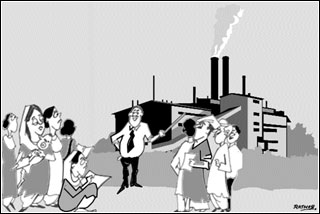 IN THIS era of globalization our country still stands at a crossroad. In the past 53 years every leader tried to rid the nation of corruption, yet the end result is that the country has landed itself in more corruption, more debt and more foreign intervention by money lending agencies.
It will be appreciative of the present rulers if they accord priority to the development of industrial human resources in the country as the UNDP’s Human Development Report 2001 presents a sour picture of Pakistan.
The report, in an analysis of our persisting economic situation, rings a strong warning bell either to make right investment choice or else face the consequences of globalization. It says technology is not just a reward for growth and development but it is an important tool for development.
The world economy is undergoing dramatic changes and the fast-paced development and advances in science and technology in the industrialized countries are steadily widening the gap between the most developing countries, consequently giving priority to the industrial human resources development and the training infrastructure to support the sustainable industrial, economic and social development.
The country has enough hard working forces, sincere manpower provided they are properly guided by putting the right man on the right job at the right time. The Machiavellian theory of finding replacement and firing needs to be discarded immediately, which will retard the brain drain of our professionals.
The lesson should be learnt from the experience of rich economies that sustained investment in human capital. This situation is now changing with globalization, increased investment and trade and the spread of technology investment in human capital.
This of course, is no guarantee to development if other relevant policies are inappropriate or are not properly implemented. But wrong economic, trade and investment policies will impair the growth to half.
Since the time taken for investment in human capital is compared to other investments, the planning period should necessarily be long and timely.
Further, unlike most other resources, human capital does not waste or diminish in value through use. Our country needs to create the condition and the environment necessary for creativity and innovation, essential ingredients for remaining competitive in the knowledge-based industries.
The globalization of production and markets, shift from the centrally planned to free-market-driven economies and the establishment of trading blocs have brought about unpredictable employment patterns. This poses a great challenge to the planners in developing countries to design and develop the right type of occupational skills at correct time in adequate number.
The lack of well-planned policies and strategy have made it difficult to establish coherent human resources development. For developing countries to become viable partner in the global economy and to derive maximum benefits from the Uruguay Round and other international economic agreements, there is need that they re-examine their policies and adjust them appropriately.
The key element in the adjustment would include the establishment of a long-term vision, strategy, restructuring the economic base, including the formation and implementation of a sound industrial policy and strategic management programme.
The policy should aim at enhancing the capabilities for carrying out industrial human resource development and training needs.
The strategy should facilitate linkage among the national educational system with the establishment of a national industrial human resources development and training fund for broader coordination with science and technology in the industry, linking the programme of light, heavy, industries to train the scientist, engineers, managers and the raw labour.
It is strongly needed that a scheme known as “learn and earn programme (LEP)” be introduced in the country keeping in consideration the following points:
(1) Development of a national policy and plan for industrial human resources.
(2) An assessment for human resources development needs be carried out with a strategic management programme.
(3) A comprehensive assessment should be carried out with a view to strengthening the existing relevant industrial training institution and, if needs arise more should be established, with particular emphasis on the development and training of industrial leaders with entrepreneurial and management capabilities engineers and industrial consultants.
(4) Establishing specialized training centres on priority basis in sub-sectors such as food technology, petroleum, forest products, micro industries electronic, engineering, textiles, etc, with special attention given to the technical vocational schools and special science and technology schools with arrangement for greater use of practical experience.
(5) At the enterprise level the public and private sector should cooperate with industrial human resources development and training institutions and universities in the formulation, financing and execution of a programme for the development and training of factory labour, mangers, engineers, technicians and other technical skill required for industrial production, quality assurance, industrial restructuring, rehabilitation and maintenance.
(6) The government and the private sector should develop a sustainable financing plan or mechanism for industrial human resources development and training including the possible establishment of a national human resources development and training fund.
(7) In negotiation with the multinational and bilateral financial institutions and the technical cooperation and development agencies such as the World Bank or the UNDP, industrial human resources development should be emphasized as an integral component of all development programmes financed by these agencies.
(8) Concerted efforts should be made towards the development and promotion of local industrial entrepreneurship, relating in particular to small and medium scale industries and micro industrial enterprise.
(9) Promotion of the local production, teaching and leering facilities with videos and radio programmes and the PTV playing a leading role.
(10) High priority should be accorded to special measures aimed at enhancing the integration of women in industry, particularly for rural areas.