



 0
0

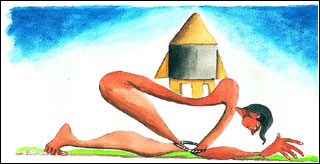 HOW does Afghanistan, a land-locked, war-ravaged country of 20-25 million people currently being bombarded to beyond even ground zero and which produces almost nothing other than some food, some fruit and a lot of poppy become economically independent enough to protect its sovereignty?
In the past 50 years or so international dole and smuggling have been its main sources of income. When the dole started disappearing in late 1980s the country became a real hub of smuggling in the region and it thrived even under ultra-religious Taliban. In fact Taliban do not consider smuggling anti-Islamic.
However, there are some, highly knowledgeable persons who somehow believe that Afghanistan’s economy has some kind of inherent resilience which enables it to bounce back as soon as it hits the bottom. They point to the ‘roaring’ economy of Herat and Khost even in these days of turmoil. There are as many as 14 car rental agencies in Herat alone. Agriculture is fairly mechanized in as many as four districts. And there are about 1000 Afghan millionaires. The land prices in Khost and Herat are mind boggling.
According to these people once peace returned to Afghanistan this ‘existing capital’ could be put to use and expand its generating capacity by encouraging the private enterprise. Meanwhile, they said institutions like a central bank, a ministry of finance, a customs department and other financial, administrative and law and order institutions could be quickly established. They suggested that in order to keep corruption to the minimum and also to ensure that no harm comes to foreigners at least in the early days of reconstruction and rehabilitation, all contractual paper work could be done in Singapore. Also, the physical link between North and South Afghanistan should be established on priority basis. Then the farm-to-market roads could be built and credit made available directly to the farmers so that they do not fall victim to the machinations of the middle-men.
For human development a consortium of universities could be set up which would be given the task of imparting higher education through the long-distance learning methods. In order to go back to the level of literacy that existed in Afghanistan in 1970, they said the country would need as many as 40,000 to 50,000 teachers. Meanwhile, they suggested that the Afghani should be demonitized and a new currency introduced because in their opinion Russia where the Afghani is printed has placed as much as one trillion Afghanis in the market over the last ten years.
Those who are looking at the post-Taliban economic needs of Afghanistan believe that to start with the international community should make available at least about 2 billion dollars and at the same time an Afghan Trust Fund of $20 billion should be established.
These people believe that once the Taliban are ousted from power and rehabilitation and reconstruction work started, the war exhausted population of Afghanistan would be only too ready to join the international peace making efforts and reject all calls to arms by the jilted warlords for renewed fighting.
Many who know Afghanistan better do not subscribe to this highly optimistic post Taliban economic scenario in that country. They say that economic rehabilitation and reconstruction of Afghanistan was going to be an uphill task and meanwhile, it will consume a lot of international dole and degenerate into a more menacing smugglers hide-out if care is not taken to divert the private enterprise to a more disciplined economic practices. Pakistan has suffered the most due to the economic waywardness of Afghanistan all these 50 years and if things are not corrected very early in the day, Islamabad would only end up facing the same situation but of more serious proportion.
If Afghanistan is allowed to carry on smuggling as it has been doing all these years of goods, drugs and guns even after the process of rehabilitation and reconstruction is taken in hand then no amount of dole or investment in social and physical infrastructure and in the producing sectors would make any positive difference to the country’s economy. And it will continue to cause serious damage to Pakistan’s economy. Here it would not be out of place to make it clear that the north-western neighbours of Afghanistan do not suffer as much as its southern neighbour does due to Afghanistan. In fact the Russians through the Central Asian neighbours of Afghanistan and in recent times these very neighbours have been using this country’s smuggling routes for the benefit of their own economies. Even Iran has used highly successfully the waywardness of the Afghan economy for its own economic good.It is Pakistan and Pakistan alone which suffers the most from Afghanistan related smuggling. And the Afghan Transit Trade (ATT) arrangement provides the needed legal cover for the economic criminals on both sides of the Durand Line.
Even if the ATT is abolished and even if you set up the most stringent system of customs at the Durand Line and staff it with the most honest of Pakistanis and Pushtuns, you would still fail to stop smuggling across the 2,500 KM long porous border that divides the two countries and which is straddled by divided families. So the only way you could make smuggling a non-profitable business is by integrating the Afghan economy with Pakistani economy. What is happening clandestinely over the last 50 years and causing serious damage to the economies of the two countries should be legalized for mutual benefit and for the benefit of the entire region because it is only by bringing some kind of an order in the economic system of Afghanistan that lasting peace could be established in that country as well as in Pakistan.
And this peace could be put to use for more economic gains for Afghanistan and the entire region by converting the country into safe trade routes for the fossil fuels of Central Asia. There are many who even believe that interested countries have managed to keep Afghanistan in a state of turmoil since the break-up of the Soviet Union simply to make it impossible for the Central Asian countries to market their fossil fuel in South and South- East Asia. If the oil and gas of Central Asia entered this market, the world oil prices would simply tumble causing the rich oil trading companies of the US and West and the rich producers like the Gulf states, Saudi Arabia and Iran to suffer enormous losses. So it seemingly serves the purpose of these rich entities to keep Afghanistan in continuous chaos. And in a way Osama Bin Laden is indirectly serving the economic interests of those very powers against whom he seems to be waging a never-ending political war.






























