



 0
0

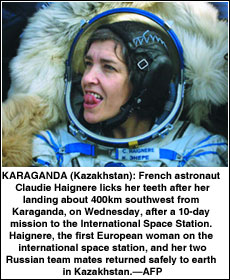 NEAR DZHEZKAZGAN (Ka-zakhstan), Oct 31: France’s Claudie Haignere, the first European woman on the International Space Station, returned safely to Earth here on Wednesday wishing only that she’d had more time among the stars.
“It all went very well,” Haignere said as she and her two Russian partners on the 10-day mission were placed in special cushioned chairs and fur-lined bags to help them readjust to Earth’s gravity.
“There wasn’t very much time,” the 44-year-old Haignere lamented on returning from her second space shot. “I would have liked to have had more time to live among the crew and to be able to look at the Earth through the porthole.”
Haignere, who spent eight days aboard the space station on a mission with two Russian cosmonauts, Viktor Afanasiev and Konstantin Kozeyev, was greeted on her return by her husband, Jean-Pierre Haignere, also an astronaut.
She said she was tired, having slept little, “five or six hours a day,” because of her heavy workload aboard the ISS.
Haignere added that she had lived and worked in the US part of the space station, and had noted “no tensions” between the Russians and the American crews. The cosmonaut, who said she telephoned and e-mailed her three- year-old daughter every day from space, added “a touch of class” to the Franco-Russian crew, according to Afanasiev and Kozeyev.
The team was expected to be flown back to Russia’s space complex Star City outside Moscow later on Wednesday.
Haignere and the two Russians clambered aboard the ISS on October 23, delivering a new emergency capsule in what was a significant boost to space cooperation between France and Russia.
Her presence on the team raised the mission’s profile, particularly in France where the media have been avid for details such as the teddy bear she carried with her into space to fulfil a promise to her daughter.
The team was charged with conducting a variety of scientific experiments under the auspices of the Andromeda programme, developed by the French Space Agency.
Haignere’s programme involved medical and biological experiments into geophysical and astrophysical states, including the development of embryos in animals, mostly frogs and salamanders, in zero-gravity conditions.
Her mission also included a study of the Earth’s atmosphere, namely the influence of aerosols on the formation of clouds.
Although Haignere was the first European woman to visit the ISS, the mission was not her first in space: in 1996 the French physician, who speaks fluent Russian, spent 16 days aboard the Mir space station.
Russia laid on almost 300 soldiers, three planes and nine helicopters to ensure that Haignere and her Russian colleagues returned safely, officials said on Tuesday.
French Prime Minister Lionel Jospin, who was visiting Moscow when Haignere started her mission, spoke with her in a brief audio-video linkup.
“I want to warmly congratulate you on the part of President Vladimir Putin and the government members accompanying me,” he told her, flanked by Haignere’s husband.
The mission highlighted the growing closeness of Russia and France in the area of space research.
Last July, Paris said it might be prepared to allow Russia to launch its Soyuz rockets from the European space centre at Kourou, in French Guyana.
Space cooperation was one of the subjects raised in Jospin’s talks with Russian officials, and Deputy Prime Minister Ilya Klebanov said earlier this month that a final decision on Kourou was likely next month.
“We expect a favourable decision” to be announced on November 15, he said, as reported by the Interfax news agency. —AFP



























