



 0
0

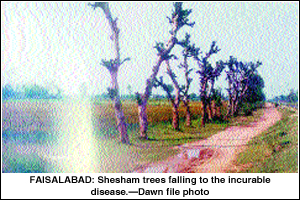 FAISALABAD, Oct 28: Scientists, pathologists and soil experts must pool their energies to combat the menace of ‘Shesham Dieback’ which is fast biting the precious species.
This was stated by adviser to chief executive on food, agriculture and livestock Shafi Niaz during a seminar on shesham dieback held at the Punjab Forest Research Institute, Gatwala, on Saturday.
He said the menace had gripped trees on a global scale and foresters from all over the world had decided to hold an international conference to discover ways and means of saving the shesham.
He said Pakistan was making every possible effort to become the venue for the conference.
The Punjab government had allocated Rs22 million for arranging a comprehensive study regarding the nature and cause of the disease while experts from Tando Adam Agriculture University were doing research in Sindh, he added.
The official maintained scientists in Pakistan Atomic Energy Commission, Forest Research Institute, Peshawar, University of Agriculture, Faisalabad and other research centres were trying to evolve a strategy to this end.
Provincial secretary (Forest) Shahid Husain Raja in his keynote address stated the problem had been ailing the country for the last three years and it was yet to be controlled.
He said dieback had been reported in technical literature in 1900 but wilt and corrosion was diagnosed during studies by the Punjab Forestry Research Institute (PFRI) in 1998.
He pointed out earlier deliberations by the professionals suggested the primary cause of dieback included a variety of physical and soil-based physiological stresses resulting from intensive cultivation of agricultural crops, extensive use of chemical fertilizers, pesticides and changed pattern of agricultural practices in the farmland.
‘We would be listening to views, experiences and results of the studies from various provinces and research institutes which would help formulating future strategy.’
Lahore Central Zone Forests (P&E) chief conservator Malik Muhammad Khan said incidence of shisham dieback in central Punjab had been a matter of serious concern to foresters and farmers since its proliferation in recent years.
He disclosed results of Rapid Rural Appraisal (RRA) indicated the symptomatic extent of damage to about 20 per cent of the trees on farmlands though it seemed negligible in public forests. Linear plantation in Dera Ghazi Khan piedmont was found severely affected, he added.
According to the chief, more than 116,550 trees had been marked for procurement of certified quality seed throughout the province while around 126,500 kilogram certified seed of the important tree species had been collected and supplied to farmers. The Punjab Forest Department fielded formations by PFRI Seed Supply System (SSS) under the Punjab Forest Sector Development Project, he continued.
Meanwhile, several other speakers conceded the epidemic had plagued trees on private and public land, causing a huge national loss.
Cleaning of water channels injured roots of the trees which ended in fungi which could be reduced if the injured portion would be dressed or sealed with grafting wax and rubber latex.
The speakers also suggested some remedial measures the application of which would reduce the risk.
They said the trees which were in their last stage must be removed so as to save other trees from catching the disease. Their stumps should be removed and with these the potential source of infection died, they added.
They continued efforts must be made to keep the ground free of decay and woody fragment.
The experts opined the trees which started showing dieback symptoms should be treated with Farm Yard Manure (FYM) through digging a pit around them.
They said procurement of plants from certified nurseries could be a real aid to the cause.
Shisham was a tree of well-drained soil which should not be grown on waterlogged, saline and compact soils.
In dry locations deep irrigation was recommended so that trees could develop deep root systems which could draw underground water when irrigation stopped.
University of Agriculture head of the pathology department Dr Sultan Mahmood, Chaudhry Zakaullah of the Punjab Forestry Institute, Peshawar, Dr GR Kurio conservator of forest, Karachi, Dr Muhammad Yousaf, chairman Entomology Department of University of Agriculture, Dr Hanif Gul, Entomologist in Punjab Forestry Institute, Peshawar, Dr Mirza Hakim, Forest Pathologist, Punjab Forest Institute Peshawar, Dr Muhammad Arshad, conservator of forests, Lahore, Syed Muhammad Navid, deputy inspector general of Forests, Ministry of Environment and Local Government, Islamabad and Arshad Ali Gill, director Pathology Ayub Agriculture Research Institute, Faisalabad also spoke on the occasion.




























