0
0

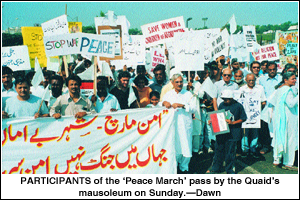 KARACHI, Oct 28: Hundreds of peace activists on Sunday tried to stage a walk — albeit abortively — from the mausoleum of the Quaid-i-Azam to a roundabout, almost within a stone’s throw, on Sharea Quaideen as policemen, armed with sticks, formed a human chain to stop the demonstrators.
The walk, which was organized by the Joint Action Committee for Peace, was intended to urge the “United States to immediately halt strikes against Afghanistan”. At first, the peace activists, carrying placards inscribed with slogans — such as “No to war, yes to peace”, “Stop killings in Palestine”, and “Look, what the super civilized and democratic world power is doing in Afghanistan in the name of justice” — lined along the pavement of the Quaid-i-Azam’s mausoleum. All this while, policemen stood hard by, eying the demonstrators warily.
Psychiatrist Dr S. Haroon Ahmed of the Institute of the Behavioural Sciences, who was waving a white flag and wearing a white hat, told Dawn that “fighting in Afghanistan is likely to destabilize the region. One can actually feel that rising level of tension between India and Pakistan”.
Talking to Dawn, the chief of the Women’s Action Forum and Aurat Foundation, Anees Haroon, said: “We reject fundamentalism and all it stands for. We do not support Osama bin Laden. But we maintain that killing innocent civilians in Afghanistan will not eliminate terrorism.”
Besides, she added, that the United States was hunting down those terrorists who had previously been on its payroll.
A member of the WAF and council member of the Human Rights Commission of Pakistan, Uzma Noorani, termed the US-led military strikes against Afghanistan a retrogressive step. She said: “Bombing a country that is already war-ravaged will serve no purpose. The United States is blatantly violating human rights in Afghanistan.”
As demonstrators began to stage a walk to the Missile Chowk — an ironical destination for a peace walk — a police party, led by a deputy superintendent of police, blocked Sharea Quaideen. After a lot of pushing and jostling, the DSP agreed to speak to the Karachi deputy inspector general of police on a mobile phone. The DIG allowed the activists to walk near the Chowk.
Uzma Noorani, who was visibly incensed at the high-handed attitude of the police, pointed out that not too long ago — last Friday, to be precise — the police had made traffic arrangements for the religious parties so that they could take out a procession on M.A. Jinnah Road.
After taking a U-turn, the demonstrators came back to the Quaid-i-Azam’s mausoleum. An activist read out the resolutions passed by the Joint Action Committee for Peace.
The following resolutions were passed: “We stand united with all peace-loving peoples of this world in our demand for a stop to war.
“We believe that war can never be a solution, particularly in this post-nuclear age.
“We denounce religious extremism, but we also believe that bombing citizens will not remove this from our midst.
“We denounce this unilateral war which is destroying innocent civilian lives and is a contemptible act.
“We demand that world powers must stop this using this ‘war against terrorism’ as a means of pushing their own agendas.
“We need peace in the region, including Afghanistan, to assure peace within Pakistan.
“Pakistan cannot carry the burden of the population migration to Pakistan.
“We believe that bombing Afghanistan is proving counter- productive as it is only destroying the homes of civilians and will result in the Afghan refugees never being able to return home.
“Any further extension of ‘war activity’ increases the chances of all forms of conflict within Pakistan.
“We want Pakistan to be made a gun-free society, as guns are the root cause of all kinds of violence.
“We do not want any action which increases the chances of violence in our country.
“We do not wish to be made a front-line state and do not want proxy war to be fought on our soil.
“This is the second time that Pakistanis feel they are being exploited by the Western powers and will be dumped, leaving a new set of problems, once their objectives are achieved.
“The people of Pakistan want a strong, peaceful and prosperous Pakistan.”
Those who attended the walk included Justice Nasir Aslam Zahid, Justice Fakhruddin G. Ibrahim, Justice Rashid Rizvi, Prof Tipu Sultan, Dr Aziz Tank and Shirin Rashid.