



 0
0

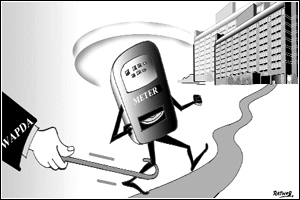 IT is a tragedy that the private sector is discouraged to contribute effectively in building the country’s economy. Initially, landlords and waderas were the ruling class but gradually the political power was possessed by the industrial class, also.
However, the role of bureaucracy has continued to demoralize the smooth sailing of private sector through its policies. The will to keep the country’s economy dependent on the IMF and the World Bank advanced, as a healthy economy could have led to wiping out of loans and bringing the country into a better economic situation.
Change of governments mattered little to the establishment due to its being the most powerful organ in the state power structure. Recent steps taken by the NRB in reorganizing the bureaucratic structure, through devolution of power, seems to be pragmatic approach but its results are yet to be seen.
The underlying idea in highlighting the power structure is to identify the bottlenecks and the difficulties being faced by the private sector in the execution of its projects. The government has, time and again, stressed upon the need for poverty alleviation by announcing various steps by encouraging the private sector involved in the housing sector.
These pronouncements are satisfying for the pubic in general and the private sector operations in particular. The housing policy revealed that the construction of 300,000 housing units annually for 20 years can hardly cope with the national demand and the government alone could not execute it thus making the participation of private sector inevitable. But, the question is, does healthy environment exists to attract the private sector in such a venture?
The limited survey of various housing societies, particularly in the Federal Capital Area and Rawalpindi has revealed that their projects were confronted with stringent bureaucratic attitude of the Islamabad electric Supply Company (IESCO) and the Sui Northern Gas. These housing enterprises, include the Bahria Town, the PWD Housing Society, the Police Foundation Housing Society, the Civilian Employees Housing Society, the Doctors Housing Society and many more.
Despite completion of the development work, these projects look deserted for want of electricity and gas. The investment of the citizens for years together is at stake, as construction of any kind cannot be executed in the absence of these two basic civic amenities.
Now the question is as to why the IESCO is not extending its support to these enterprises knowing very well that construction in the housing sector will create huge economic activity leading to the circulation of money and the receipt of revenues by the government. Straight and simple answer is that the approach of Wapda and its distribution companies like the IESCO does not conform to commercial needs.
Unluckily, Wapda’s monopoly in the country has led to a chaotic situation. The powerful Wapda is paying to the IPPs almost Rs7 billion annually as the non- utilization charges of 2000MW power which is yet to be distributed among the consumers! No doubt, the commercial offices do exist, but the makers of policies are yet not clear on the subject of operating it on commercial basis as their perks are only safeguarded by adjusting more premium on electric utility bills. In case, Wapda’s top management is not in a position to manage its affairs, then it should think of devolution through the induction of private sector.
It is a pity that the consumers are following Wapda for getting the electricity, whereas it should have been vice versa. There are no two opinions that the provision of power to housing societies and other similar enterprises will give a healthy jolt to the economy.
At present, Bahria Town happens to be the largest housing project in the country which is located adjacent to the societies like the PWD, the Police Foundation, the civilian employees and others. In case the housing units of these societies are put together, construction of almost 12,000 units will be initiated and the fiscal combinations and permutations will be quite optimistic in supporting the existing dwindling economic activity in this sector.
The emphasis laid in the national housing policy, by offering incentives to the private sector, is a lead in understanding the graveness of the problem. Perhaps, there are some rigid bureaucrats who prefer to sacrifice the national interest at the altar of their so-called principles. The government must come to the rescue of consumers in getting their due rights on time.
The wilful delay in processing the power supply demand is a bureaucratic chess-like move, which can neither be comprehended nor taken cognizance of by the relevant agencies. The delays are always on the pretext of the non-compliance of documentation whereas, such documentation is demanded in bits and pieces with ulterior motives. This is equally applicable to other government set-ups and a common man suffers.
There is a real need to carry out an appraisal of the IESCO as to what projects it has electrified leaving aside the CDA, during the last 4 years in the Federal Capital Area and Rawalpindi and how much state revenues have been “lost” due to its “technical” knock-outs. The data will be interesting and a scrutiny can definitely unearth the quantum of loss done to the state on this account. Needless to emphasize that the IESCO is not charged with the only task of revenue recovery but it has the prime responsibility of generating revenues for Wapda and extending essential civic amenity of power on priority by doing away the inefficiencies in the system and in distribution network.
The NRB may also enter into this monopolistic conglomerate and see how this sacred cow is behaving and making fool of the entire nation. The claim of the present government to transfer power at the grassroots level by devolution strategy is a welcome move but let us not forget to overpower the power which claims to have its own governance devoid of state authority. How far this claim is correct, it needs probing but the common man needs power as a civic amenity without being educated on power source at the state level.





























