0
0

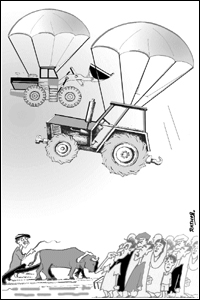 THE cotton season is coming to an end. Picking has been completed in southern Sindh and is in full swing in northern fields of Sindh and all over Punjab.
Hopefully, growers would get a fair deal. This is important because if picking is delayed due to financial woes of farmers,—the next crop, wheat,— lifeline for agriculturists and vital for food security in the country, would get the wrong start.
Portents for wheat are not favourable. Reports of water availability are extremely disturbing. A 51 per cent shortage of water has been assessed. Considering that weather has hit a dry streak, shortage is likely to be more acute. Last year’s shortfall was 43 per cent.
The government is finalising its water distribution arrangements and that may have been done by now but it is clear that no amount of management would increase water resources. It is, however, possible to obtain the maximum from available water. Punjab is in the news for reduced water supply because Mangla dam would have to be closed for brief periods during the rabi crop but that would ultimately reflect on the quantity, as also quality of the produce.
Pakistan produced excellent wheat crops in the preceding two years. Farmers were however the loser. Things were bad the year before and terrible last year. In many parts of the country, farmers were forced to sell their produce even at 50 percent below the official support price. At a time when the farming community expected to earn a little extra and make up for losses in other crops, particularly wheat, they were deprived even of returns commensurate with their investment not just of time and labour but financial inputs as well.
This isn’t the kind of situation that encourages farmers to put in a greater effort. The year before the last, they survived because of the high yield and earned some profit because of the quantity of produce. But last year’s procurement drive left growers high and dry. Financially resourceful groups stepped in to purchase wheat from farmers that had been pushed to the wall by the inefficiency, and corruption of food departments of Punjab and Sindh, particularly the former.
Rake-off experts and middlemen, in connivance with officials, skinned of farmers. They sold wheat at whatever price they were offered as they were under the pressure of financial requirements for raising the cotton crop.
Many farmers were left with the unsold crop as they had no means for stocking. Somehow or the other, they raised resources for cotton. One hopes that for once, the TCP rises to the situation and helps growers obtain the proper worth of their sweat and toil.
However, that alone would not be sufficient to ensure a good wheat crop because of numerous negative factors. Placing farmers in a financially better position is essential; they should also be motivated for producing their best. But they would need to be supported in other ways too if the country is to produce enough food for domestic needs. They must be provided the latest technical know-how to enable them to meet the twin pressure of shortage of water and rising cost of production.
The way out seems to be conservation agriculture. Pakistan has made a breakthrough in that field during the last two years but progress has not been fast enough to cover the entire land; in fact the use of conservation agriculture is still in an embryonic stage.
It is restricted to a few thousand acres for lack of availability of equipment. The federal government had commissioned the production of zero tillage machinery for distribution to the provinces but that has not been done so far with the result that although conservation methods have been vastly accepted by farmers due to untiring work of On Farm Water Management Wing of the Agriculture Department of Punjab, machinery is in short supply.
Laser levelling, zero tillage and bed and furrow plantation techniques have been effectively demonstrated to farmers who are convinced of the benefits that would accrue to them by using conservation methods and technology. It has proved its worth for increasing yield, saving on diesel and fertilizer and exploiting the residual resources of the land.
In direct terms, the cost of fuel is cut down by 20 to 30 US dollars. That takes some burden off the farmer’s back. The yield is raised by as much as 17 per cent and a farmer saves up to Rs1,000 per acre. In these times of rising cost of production, this is a major benefit for the farmer.
This is an immediate benefit. In the long term, the quality of land is protected; land is saved from degradation. From the viewpoint of food productivity of the country, this aspect alone justifies intensive use of conservation technologies. The concrete mileage is an increase in his income by about 20 to 25 per cent.
However, in the present scenario of water scarcity, the most notable mileage from conservation is its water preservation potential. It saves about 20-25 per cent use of water. The levelling of the fields makes for smooth and efficient flow of water and this aspect cannot be over-stressed in view of the shrinking water resources of Pakistan. The new technologies have been accepted as beneficial to environments, conducive for higher production and conservation of resources, particularly water at the international level. Countries that have no shortage of water are turning to them because of their impact on environments, besides the fact that they reduce the labour put in the fields by farmers.
The government has accepted their efficacy at the highest level but the authorities have been slow in providing the needed support to the farming community. Big landowners are reportedly applying them but small farmers do not have resources for converting themselves to these technologies. They need the government’s patronage.
If Pakistan is to keep its struggle for obtaining food sufficiency, a crash programme for disseminating these technologies and making the equipment available at the farm level is not just essential; it is a crying need of the sector. Delaying their mass level application would put the country behind its food needs and worse still, force it to import more food, something the country can ill afford in the present state of the economy.