0
0

KARACHI, Oct 25: Speakers at a seminar on “Combating Environmental Pollution”, organized by the Pakistan Press Foundation here on Thursday, said that since there was no clear- cut policy regarding environment protection and pollution control in the country, increasing urbanization in Karachi might lead to a serious crisis in the future.
Karachi Traffic DIG Mohammad Yamin Khan emphasized the role of the public in combating air and noise pollution. He said that more than a million vehicles plied about 8,000 kilometres of road network in the city.
About 80,000 vehicles had been fined in 2000 for different offences, including emitting excessive smoke, creating noise pollution due to faulty silencers and using pressure horns, he said.
He added that about 80 per cent of the vehicles in Karachi were private cars and motorcycles and the police alone could not control these pollution factors if the masses did not avoid using pressure horns.
He said that major contributors of pollution in Karachi were buses and rickshaws, deploring that 40-year-old buses were plying in the city. He added that as many as 25,000 rickshaws used faulty silencers.
He informed the audience that 25 per cent of rickshaws had been converted to combined natural gas.
Regarding fatal traffic accidents in Karachi, the DIG said that the figures had considerably declined from 11 deaths per 10,000 vehicles in 1995 to six in 2000.
Mr Khan said that in order to control the fast deteriorating situation the number of private vehicles and old-model buses must be reduced, and long buses and better public transport system was needed.
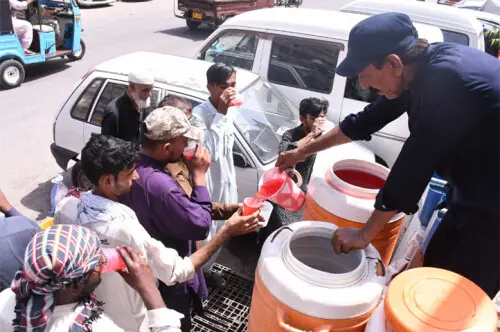
Dr M.A. Altaf, chairman of the department of environmental studies, Karachi University, spoke about water pollution and said that about 10 million people died of water-related diseases every year all over the world.
He said that though more than 80 per cent of the world was covered with water, but only three per cent of it was potable.
He emphasized the importance of water, quoting verses from the Quran. He called for more efficient ways to protect potable water resources. Dr Altaf said that water pollution was a serious problem in Karachi which was aggravating with the passage of time due to high growth rate of the city.
There were more than 50 different types of water-related diseases in Karachi, he said, adding that 97 per cent of 2000 water samples collected by the department of environmental studies of Karachi University had been declared unfit for human consumption.
This problem did not only exist in the urban areas of Pakistan but also in the suburbs and rural areas where shrinking water reserves were often shared by human beings and animals. Though it was harmful for prolonged use but we had become resistant to these microbes due to prolonged use, Dr Altaf said.
However, he suggested that boiled water be used as it was the best available solution to water-borne diseases.
Asma Hussain, coordinator of Society for Conservation and Protection of Environment, emphasized the need for strict government regulations regarding proper and scientific disposal of hospital waste.
She said that studies had shown that only 10-15 per cent of hospital waste were hazardous but it was a common practice in hospitals to mix bio-chemical waste and general waste making proper disposal difficult. In the absence of clear laws in this respect, hospitals were not bound to cooperate with the civic authorities (the city government) to give all hazardous waste for proper disposal, she said.
She said that the most economical way of separating hospitals’ hazardous waste from general waste was to keep different coloured waste bins for different usage and the hazardous waste should be given to the civic authorities for proper disposal.
Khalid Jawaid, district officer, Solid Waste Management, Karachi City Government, said that the main problem faced by the city government in this regard was transportation of garbage from localities to three landfill sites which were about 30 to 35 kilometres away.
He said that Karachi generated 6,000 tons of garbage daily of which about 5,500 tons came from the City government limits, while it had the capacity to lift only 60 per cent of it.
The remaining 40 per cent garbage got rotten at open plots, burnt down, collected by Afghan scavengers and thrown into Lyari and Malir rivers.—PPI