



 0
0

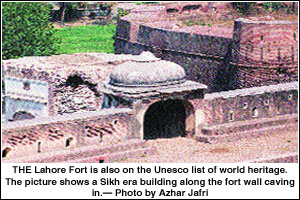 LAHORE, Oct 22: The federal archaeology department has taken a significant step of sending a reference to Unesco for including six more 17th century monuments on its world heritage list.
All these monuments belong to the Mughal period and were built between AD 1606 and 1645. They are: the Tomb of Jahangir and its Akbari Serai and mosque, the tomb of Asif Jah, the tomb of Noor Jehan in Shahdara, Lahore, the fort in Sheikhupura and Hiran Minar near the city.
The move for the Unesco patronage of these monuments came about a year ago and the Paris-based world body asked the government to give a complete description of these buildings.
The accompanying government declaration rates the monuments “on a par with India’s Taj Mahal and Qutub Minar in architecture, design, material and workmanship”.
Pakistan already has eight world heritage monuments: the Lahore Fort, the Shalimar Gardens, Jhelum’s Rohtas Fort, Taxila, Takht Bai’s Buddhist remains and the adjoining ancient city of Sri Behlol near Mardan, Makli Graves near Thatta and Moenjodaro.
The federal government hopes the world body will enlist all other six monuments on its world heritage list because “Unesco has given positive response so far”.
Unesco had a total of 507 world cultural and natural heritage monuments in 108 countries till 2000. Its World Heritage list comprises 381 cultural, 107 natural and 19 mixed places of outstanding universal value. They include buildings, ruins, ancient cities, natural sanctuaries and parks.
Their maximum number in one country is 23 and they are in Spain. It is followed by 22 in France, 21 in India, 19 in Germany, 18 in the US, 17 in Italy, 16 each in Britain, Mexico and China, 14 in Greece, 12 in Canada and 11 in Russia.
The concept of having a world heritage programme was mooted in 1972 and Unesco organized a general council which adopted a convention on November 16 that year. The convention put the world community under an obligation to join hands for the protection and preservation of monuments and other heritage of outstanding universal value.
The convention says: “... the deterioration or disappearance cultural or natural heritage constitutes an improvishment of the heritage of all nations of the world;
“Protection of this heritage at national level often remains incomplete because of the scale of resources which it requires;
“Parts of cultural or natural heritage are of outstanding interest and, therefore, needed to be preserved as part of the world heritage as a whole;
“In view of the magnitude and gravity of the new danger threatening it, it is incumbent on the international community to participate in the protection of the cultural and natural heritage of outstanding universal value”.
The Unesco general council set up a World Heritage Committee and created the World Heritage Fund for technical and financial assistance of preservation and conservation of such heritage. The committee was assigned the job of preparing a list of endangered monuments and member-states were allowed to seek assistance for the conservation of those monuments which were then put on the world heritage list.
The preservation of Moenjodaro is an example of financial and technical assistance which the world community has so far extended.




























