0
0

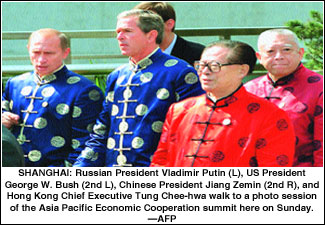 SHANGHAI, Oct 21: Asia-Pacific leaders issued an historic anti-terrorism accord on Sunday as they ended the biggest international gathering since Sept 11 with a pledge to limit the economic fallout of the attacks.
The leaders of the Asia-Pacific Economic Cooperation (APEC) forum, including US President George W. Bush, condemned the airborne suicide attacks on New York and Washington as “murderous deeds”.
The denunciation came in the first ever political declaration by the 12-year-old APEC, in the form of an anti-terrorism statement issued in Shanghai that called for “a major role” by the United Nations in the war on terror.
Bush had sought to rally support from the 20 other APEC members for his campaign against Taliban-ruled Afghanistan and the broader war on terrorism as he ventured overseas for the first time since September 11.
The APEC statement made no mention of the Taliban or suspected terrorist mastermind Osama bin Laden, amid opposition to the Afghan strikes from largely Muslim APEC members Indonesia and Malaysia.
But the United States played down the omission. It was “not a setback at all”, said a senior administration official.
“We’re thrilled with the statement,” the official said, citing its measures committing APEC members to clamp down on terrorist finances and strengthen aviation security.
“What we were looking for was what we got. We didn’t need more from this group.”
The united stand against terrorism was a major departure for APEC, which has traditionally focused on economic goals such as advancing free trade.
On more familiar ground, leaders including Russian President Vladimir Putin and Chinese President Jiang Zemin called for a new round of World Trade Organisation talks next month and for APEC to advance its own trade goals.
“We are determined to reverse the current economic downturn and maintain public confidence at a time of uncertainty by fighting protectionism and committing to the launch of the new WTO round at the upcoming WTO ministerial conference,” the Pacific Rim leaders said in another declaration.
Continuing an APEC tradition of dressing in locally-themed clothes at their annual retreats, the leaders had decked out in matching Chinese silk jackets as they convened in the morning at Shanghai’s Science and Technology Museum.
But a Taiwanese boycott of the summit, in protest at rival China’s refusal to let the island send its envoy of choice, marred the display of unity at the biggest international meeting ever held in China.
None of the leaders mentioned the boycott during a morning session of talks, a Japanese foreign ministry official said.
In their anti-terrorism statement, the leaders condemned “terrorist acts in all forms and manifestations, committed wherever, whenever and by whomsoever as a profound threat to the peace, prosperity and security of all people, of all faiths, of all nations”.
“Terrorism is also a direct challenge to APEC’s vision of free, open and prosperous economies and to the fundamental values that APEC members hold.”
The statement said “it is more important than ever” for APEC economies to achieve their “Bogor Goals” of free trade by 2020.
The leaders pledged to review progress towards the goals, named after an Indonesian hill resort where APEC met seven years ago, in 2005 amid criticism that the grouping’s free-trade drive has failed to make much headway.
The agreements reached during the Shanghai summit masked divisions over the tactics that Washington is pursuing in Afghanistan.
Indonesian Foreign Minister Hassan Wirajuda warned of an “explosive” reaction in the Islamic world if the US campaign in Afghanistan continued into the Muslim fasting month of Ramadan, starting mid-November.
Malaysian Prime Minister Mahathir Mohamad reaffirmed his opposition to the US-led campaign but said the use of ground forces was at least preferable to air raids that attacked “children on the street and pregnant mothers”.
During bilateral talks on Saturday, Jiang and Putin called for a speedy transition from the military campaign to a political solution for Afghanistan’s long-running problems, officials said.
After separate talks between Bush and Putin late Sunday, the Russian leader said he and Bush “made some progress” on the future of the 1972 Anti-Ballistic Missile Treaty.
But Putin reiterated support for the treaty, which Washington wants to scrap to build a missile shield opposed by Moscow.—AFP