



 0
0

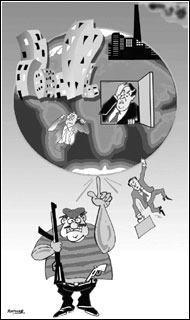 THE USA, together with international community, has launched ‘Operation Enduring Freedom as a result of what happened on 11th September, 2001, in New York and Washington.
A system based on most sophisticated technology was beaten by low-level technology i.e. small knives, human muscle power and converting a commercial plane into a bomb of nuclear dimensions. The silos of all nuclear weapons and sophisticated missile technology failed to prevent the catastrophe. Therefore it would be safe to conclude that the tenor and thrust of the ‘Operation Enduring Freedom ‘ must necessarily be different than the present military wisdom.
There are many contributory factors to terrorism and the most critical is, the ‘injustice galore’ —being caused on a global basis. Hence the ‘Operation’ seems very timely. In the main, three streams serve as the spawning grounds for terrorism. The first and foremost is economic. Unfettered capitalism, globalization, wrong policy prescriptions, misdirected bilateral and multilateral lending, debt traps and the increasing burden on have-nots are some of its manifestations. The second is ‘double standard’ in formulation and application of foreign policy, in several cases, by US and its allies. The third is the gradual building-up of prejudices, bias and cliches in the West by media and pseudo-intellectuals raising the bogey of fundamentalism, etc.
In this article however, we will analyze how much significant are the economic factors and how economic forces can be harnessed to combat terrorism.
It is worthwhile to note how the economic indicators have changed during the last 50 years. In 1950, world population had increased by 37 million and in 1999 by 90 million. During 1950-85, world food production increased at an average growth rate of 2.6 per cent but since 1992 it has declined to about 1.5 per cent. The world oil reserves and the coal production are declining. There is an imperative need to harness solar energy on an increasing scale. Sustained economic growth, which is vital for reducing long-term poverty “still eludes half the world economies”. According to the UN report, “more than 30 per cent of the real per capita incomes have fallen over the 35 years” and, “people in industrialized countries were 74 times as rich as those in the poor countries. Three rich men have wealth greater than the combined GDP of all the least developed countries which have a total populations of 600 million”.
The disparity in per capita income between the poorest and the richest countries was one to twenty, about 50 years ago. In the late nineties, it has increased to one to three hundred. Within the richest countries also the income disparity has widened spawning growth of mafias and terrorists.
About one-fifth of the world population lives in absolute poverty, struggling to survive on less than $370/- a year. The UN and the global financial institutions issued a report in June 2000 which indicated that the number of people living in absolute poverty has grown to 1.2 billion from about 1 billion since the famous Copenhagen meeting of world leaders in 1995. This shows that global poverty is on the increase.
A chunk of the loans made by multilateral financing institutions like the World Bank and the Asian Development Bank [ADB] are largely used to finance purchases of what the corporations in ‘donor’ countries have to sell. These includes products and consultancy services which are included as part of the project aid. Statistics show that for every dollar the US government extends as aid through the World Bank and other regional development banks, about two are spent on the US economy. Third World countries provide ample opportunities for productive and profitable investment of US capital and technology while the developing countries are significant markets for US corporations, accounting for more than one-third of all US merchandise exports in 1997.
The US economy,the largest in the world, suffers from increasing income disparity. In 1929, the year the Great Depression began, just one percent of Americans owned 36 per cent of the national wealth, their share fell to 21 per cent by 1949. It then began a steep climb and by 1997 1 per cent of American owned 42 per cent of the country’s total wealth.
Globalization became a world slogan, particularly in the last decade of the 20th century. Despite its much-publicized promise of advantages that would accrue to the world particularly the developing world, its actual effects on the life of the people have not been beneficial. There have been global frustrations as have been evident from series of protests and demonstrations in front of World Trade Organization and the annual meetings of Bretten Woods organizations in the second half of 1999. The period since the Copenhagen meeting according to the Chief of the ILO “is a strong indictment of globalization and the global economy. We can no longer give globalization the benefit of doubt. The results are in and it flunked.” The UN secretary general also blamed globalization for causing widespread suffering. With clever devices and luxury-prone ‘mantras’, the global wealth has been so re-distributed as to concentrate it in the hands of few countries. Let us recapitulate in capsule what are those ‘mantras’:
Globalization: a sugar-coated mantra like “One World Government,” “World harmony” and “International Peace and Cordiality.” The deep core of this mantra contains nothing but exploitation of the weak economies of the world. In fact, it is nothing but neo-colonialism.
Free-market etc: ‘Mantras’ of capital markets, free market and private sector, which enable three trillion dollars to move to and fro in various forms such as hot money, foreign private investment, and international investment banking - all designed to suck more from the recipient. Volatility in foreign exchange markets is not good for emerging economies. The financial systems are bearing the brunt of the globalization of markets.
Foreign aid etc: ‘Mantra of ‘foreign aid’ which enables donor nations to promote their own financial and economic interests, through financial and technical assistance. In other words, there has been less economics of aid but more politics of aid, the purpose being to get indirect political control on the resources of the developing world;
Ethics of aid: In many cases, aid has been so unethical as to spread corruption, VIP culture, and social discrimination with the hidden agendas of acquiring economic control, through political henchmen as in Pakistan.
‘Foreign private investment’: Foreign private investments which enabled the multinationals to a get a foothold and subsequent control of the economies of developing world. Most of the East Asian and Latin American countries economies were enchanted by this mantra;
‘Glasnost”: ‘Glasnost’ and ‘perestroika’ which disintegrated the Soviet Union and brought unprecedented misery and hardship to economies of the developing world.
These ‘mantra’ are applicable only to the industrialized and the newly industrializing countries [NIC] which have options. For one third of the world’s poor and marginalised, these mantras do not work as they have no economic choice except basic necessities like foods and shelters. The balance one-third is caught in the whirlpool of rising expectations and continued deprivations.
Almost 50 years have passed since the ‘gospel of economic aid’ is ringing in various tunes. At best, only a few countries have been able to solve their economic problems. Others have simply become aid-addict, as has been the case of Pakistan. During such a long period of 50 years, the two Bretten Woods organizations have not been able to accomplish the task of alleviating poverty and the world stands polarized It is this polarization that breeds international terrorism.
The ‘Operation Enduiring Freedom’ cannot succeed unless global disparity is removed, economic resources shared and removal of economic injustice becomes an integral part of this operation. As Wily Brandt eloquently emphasized ‘while hunger rules, peace can not prevail”. Any one who wants to ban war must also ban poverty’.
Here a 6-point programme outlining a strategy to achieve this goal is suggested:
(I) A restructuring of world economic order following a global Summit;
(II) A restructuring of the role of the IMF, the World Bank, the ADB, the WTO and strengthening the role of the UN in various economic fields;
(III) An adequate representation of the developing countries in the UN and multi-lateral organizations including the IMF, the World Bank and the ADB;
(IV) An effective supervision of the major financial markets including hedge funds, currency traders and hot money operations.
(V) A well-coordinated strategy for global debt reduction, together with the efforts about global poverty alleviation;
(VI) Adoption and implementation of people-oriented public policies, mainly in the developing world to ensure heavy investment in health, education and social security;
A new social order will unleash forces which should be directed against, (i) market fundamentalism, (ii) religious fundamentalism and social liberalism. The concept of market fundamentalism as advocated in 1990 by ‘Washington Consensus’, the new liberal orientation of the IMF/World Bank and the US Treasury centres around total deregulation, privatization and unbridled globalization.
This is a piece of ‘voodoo economics’ which caused disastrous results in Russia, East Asia and many other African countries. The “free market’ mantra has its own limitations. It does not work among the poor and hungry as it has failed in allocating economic resources in a prudent manner in the developing world. It has failed to alleviate poverty and to put aD stop to deprivation of the largest segment of people in Asia, Africa and Latin America.
Let the policy makers of international community including the United States be guided by the wise remarks of late President Roosevelt at the end of the Second World War: ‘we look forward to a world founded on four essential forms of human freedom - freedom of speech and expression, freedom of worship, freedom from want and freedom from fear’. Can President Bush lead us in founding such a world?



























