



 0
0

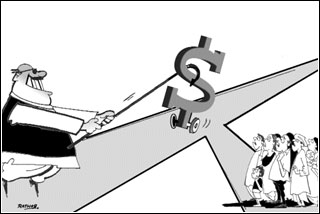 PAKISTAN, caught in a deadly debt trap, struggling hard to get rid of external loans of $35 billion. There seems no hope to come out of this crisis or to stop looking towards IMF, World Bank, Paris Club, London Club and ADB in near future.
There are no signs yet for overcoming the ever-increasing fiscal deficit, the worsening balance of payments and unfavourable trade imbalances. The borrowing spree of the successive governments in Pakistan, civil and military alike, has never stopped. They have been getting loans from wherever these were available without ever thinking or realizing how to return these. The government borrowed Rs 135 billion from the State Bank in the fiscal year 1999-2000. This borrowing was not in conformity of the credit plan which the government was supposed to make a net credit retirement of Rs15 billion instead of borrowing anything from the banking system.
On the other hand the private sector and public sector commercial enterprises together borrowed Rs23.1 billion against a combined credit plan target of Rs104.5 billion. Of this Rs 15.4 billion went to the private sector proper. In 1998-99 the private sector had received Rs 68.9 billion-bank credit. The government borrowing of Rs 135 billion in 1999-00 that was 15 times higher than its 1998-99 borrowing of Rs8.9 billion helped it retire commercial bank credit of Rs95 billion and left Rs 40billion in its coffers to fill in the gaps between income and expenses. And since the money borrowed from SBP was cheaper then the credit retired because of the difference in their pricing structure the government also benefited in the shape of low cost of credit retirement.
All governments during the last 30 years failed to utilize foreign lending properly and never gave a serious thought to the idea of living within means. The present economic crisis is a logical outcome of the wrongdoings of the last three decades. Unfortunately the IMF and the World Bank-trained Pakistani economists, instead of advising the concerned quarters to enforce financial discipline, always defended such elements. In addition to the external debt of $40 billion, the government had borrowed Rs 2000 billion from the Pakistanis.
The government of General Pervez Musharraf constituted Debt Reduction and Management Committee (DRMC) to evolve a strategy to come out of the debt trap. Dr Pervez Hasan, the Chairman of the Committee, in a number of press interviews claimed that Pakistan could kick-start the economy without much new investment by adopting a nine-point strategy on a priority basis.
Dr Hasan submitted his interim report on debt reduction in the Cabinet meeting of Nov 2, 2000 and also made a presentation on the occasion. Reportedly, he was disillusioned as there was no will to implement his proposals, He calls his committee as debt burden reduction committee rather a simple debt reduction committee, admits that our debt ‘burden’ has become really acute in the three years since 1996 as during this period there was zero growth in revenue collection and exports while borrowing for current expenditures kept on going up.
The official thinking about Pakistan’s debt burden lacks any in-depth perspective, it conveniently ignores the political dimensions. The political elite besides indulging in corruption, also trued to please the military establishment by giving them more than what was due. The military establishment, even when not in power, controlled the main policies of civilian regimes. The civilian rulers always worked under pressure of this institution. In the name of defence, the military establishment managed to eat the biggest chunk of the cake and resultantly the State is now virtually bankrupt,
The government of Gen Musharraf on the one hand, is seeking advice and expertise of persons like Dr Hasan for the retirement of debt and on the other has been toeing the IMF line in letter and spirit. It is a strange dichotomy. It shows how confused in their thinking are the present military rulers of Pakistan. They have been put in an awkward position by the international forces, which want to cripple this State to blunt its nuclear teeth. The military regime wants recognition as representative of Pakistani people’s actual aspirations, but lacks economic viability for any international acceptance. Pakistani defence experts regard the nuclear capability as a great achievement, but economic bankruptcy has almost neutralized this otherwise very effective military weapon.
There was a mood of jubilation in official quarters when the IMF finally cleared (on 30th November 2000) a much sought- after letter of intent (Lol) to Pakistan for a $596 million new SBA. The military government was said to have been given to understand that the continued revenue slippages could cause the discontinuation of SBA, like that of the previous $1.5 billion Extended Structural Adjustment Facility (ESAF). According to the officials of the ministry of finance, the government had no option but to accept the IMF conditionalities of strict enforcement of GST, removal of the indirect subsidy on gas and bringing down the import tariff to 25 per cent by 2003 to meet the criteria of the World Trade Organization.
The debt trap, in which Pakistan is caught, is a multi-faceted phenomenon; economic political and social. As international donors are tightening their noose around Pakistan’s neck, the negative effects of conditionalities are becoming more and more visible. In the frenzy of collecting more and more taxes (through oppressive means), the rulers of Pakistan are making the lives of common people miserable. Today’s Pakistan is trapped in a vicious debt trap whereby it needs to borrow more than Rs 600 million every single day of the calendar year to survive. That translates into an additional debt of Rs 50 million every working hour of the day, Rs 800,000 every minute or close Rs 15,000 every second. Fiscal and monetary policies are inextricably linked with debt management.
The struggle to keep fiscal deficit to sustainable levels is becoming more and more difficult with each passing day. The fiscal authorities are caught in a vicious circle of offering higher and higher rates of return, which raise the cost of borrowing to unacceptable levels. Increasing the monetized deficit in this difficult situation can unleash a growth of primary liquidity with consequential acceleration in inflation. It is thus, becoming crystal clear that an unsustainable deficit is bound to have a destabilizing impact on the economy.
Since October 2000, there is no reduction in the level of political uncertainty, as concerns still persist about the outlook on democracy front. General Musharraf’s Administration has already delayed the implementation of difficult economic reforms. The level of public discontent remains high and the weak performance of the economy continues unabated. While official donors continue to press the military government to speed up the timetable to return the country to democracy, no dates have been set for national elections and the review petition dismissed by the Supreme Court has given a new boost to military regime to even demand a permanent role in future polity. The country’s political institutions will, therefore, remain weak. Restoring faith in these tarnished institutions is likely to remain one of General Musharraf’s administration’s greatest challenges.
According to the State Bank Report 2000, “the increasing level of debt stock of Pakistan has led to a sharp increase in debt servicing over the period 1st July 1996 to 30th June 1999. At its present level, interest payments on domestic debt account for 46.7 percent of tax revenues, and 25.5 percent of total expenditures. The rescheduling of external loans has not had any impact on Pakistan’s rupee debt servicing. All rescheduled repayments still require the borrower to make rupee payments to the SBP according to the original schedule of repayments. This has been done to insulate the impact of the external constraint (which required the rescheduling) from the performance of Pakistan’s fiscal system. Since payments on external debt are a significant part of total debt servicing, it is important to make sure that the leeway provided in terms of hard currency payments was not being reflected in lower debt servicing”.
Since December 2000, the annual debt servicing is around $4.6 billion, while the current account deficit is in the range of $1.7 billion to $2 billion. Financing a total obligation of $6.3 billion from internally generated funds is proving to be a highly unlikely scenario. Thus further external funding is inevitable for economic survival in the near future. The tall claims that in three years’ time Pakistan will pay off the entire external debt is nothing but an eyewash. The government’s policy of implanting the IMF-proposed reforms is evident of continuous dependence on foreign assistance. The long-term external debt scenario has never been planned in the past, resulting in the current debt mess.
The problems in Pakistani economy can be summarized in one word, which is ‘instability’. The military regime, just managed to squeeze meagre Rs11 billion through a highly publicised Tax Amnesty Scheme 2000. The real tax potential of undeclared wealth is between Rs700-1000 billion, according to very conservative estimates. The successive governments have utterly failed to convince the Pakistani people for paying the taxes due from them. The common argument against paying taxes is that money so collected is spent for wasteful purposes and on unprecedented benefits enjoyed by high placed civil-military bureaucrats and corrupt politicians. In this tug of war, the tax machinery is minting money by harassing the public in the name of army rule. This is the first time in the history of Pakistan that a military take-over has become a tool in the hands of tax bureaucrats for exploiting the general masses for self-interest. The small businesses have been asked to pay a minimum tax of 0.5 per cent on their turnover irrespective whether they earn taxable income or not. The larger business houses and big industrialists have been threatened through the institution of National Accountability Bureau (NAB). The result is that everybody is removing capital out of Pakistan and foreign direct investment has nose-dived.
On the one hand we are destroying the available capital, industry and human resource and on the other for economic growth we have heavy and persistent reliance on external loans and credits. The IMF is nowadays imposing tougher and even contradictory conditionalities on Pakistan, The donor countries have their own political strings attached to the loan facility. The IMF is certainly advocating an unjust ‘global trading system’, as a chosen instrument for imposing imperialistic financial discipline upon poor countries. They are destroying the industrial base of Pakistan and forcing its markets to open up for goods from the developed countries.
It is an undisputed fact that the IMF conditionalities have aggravated the inequalities of income and wealth in Pakistan and resulted in more unemployment. The IMF conditionalities have caused more harm to us than doing anything real good. It is therefore, painful to note that every government in Pakistan, including the present one, continues to take loans by accepting and complying harsh the IMF conditionalities.
Pakistan’s economy during the past fifty years can be described as a classic example of a case where artificial prosperity was maintained by heavy doses of foreign aid and overseas remittances of Pakistanis. Though during the initial years a section of the ruling elite did think in terms of building a self-reliant economy, it remained only a concept. Easy and cheap availability of goods and services through foreign aid discouraged the development of a large-scale indigenous industry.
The formation of elite groups has further strengthened the feudal mindset and behaviour of the small ruling elite that moves in and out of power at various intervals and capture most of the rents for itself,. This class was attuned to the client-patron relationship. The economic rents created through import licensing, industrial permits, foreign exchange allocations, credits by government banks, tariff concessions, subsidized agriculture credit, tax evasions were some of the tools for the elites to thrive. Studies have shown that the lowest 20 per cent of the population in Pakistan received 7.3 per cent of the income whereas the highest 20 per cent received 44.5 per cent of the income.
It is a unanimous view among economists that Pakistan’s economy has been mismanaged since its independence in 1947. The little development that took place in 1950s and 1960s was merely accidental. In addition, the absence of institutional frameworks for the governance of the State to channelize the aspirations of people has resulted in a chaotic situation. In normal circumstances, the people only would have suffered. The money that flowed into the Pakistani economy was largely borrowed from both external and internal sources. The money so borrowed was not used for any productive purposes.
The situation was further aggravated due to financial indiscipline, rampant corruption and wasteful expenditure by all the successive governments, both military and the civilian. The borrowed money was always used for wasteful purposes. A recent report in press exposed that the regime of Gen Musharraf wasted millions by appointing handpicked so-called economic experts. A few of them, who were assigned the job of reforming tax structures, were not even familiar with the basic principles of taxation, yet received million for the job they never performed.



























