Rags to riches and vice versa
(Click on images and videos to enlarge)
There is gloom here at the Sundar Industrial Estate, my first stop over. It is just outside Lahore and adjacent to the sprawling Sharif Palace at what is known as Jati Umra. People are not happy and it's not about the routine rants against mehngai and bijli.
Lahore is bursting at its seams. This spillover of urbanisation is brashly displayed in the suburbs. There are posh gated colonies with private golf courses, grand campuses of expensive universities and industrial complexes that are mega by Pakistani standards. All of these have encroached upon agricultural land. If you venture out on Raiwind Road for a long drive these days, you will find intermittent yet vast stretches of golden wheat fields all around. But don't get deceived. The crops are just 'the caretakers' of the land that is destined to graduate to the status of real estate.
This transformation of a livelihood resource into a commodity that is traded and speculated upon is a major determinant in the politics of this area. There is no comparison between the price of a piece of agricultural land and its price after commercialisation. The midas touch can easily convert a lakh into a crore or even more. The amounts that the land developers can pay farmers are mind boggling. The novo rich ex-farmers are abound here, and jostling for political representation.
On my way, I met an upstart leader of the Gujjar biradari who is aspiring for a ticket of the Pakistan Tehrek-I-Insaf for the Punjab provincial seat, PP 161. His family has been with PML-Nawaz for years. He claims to have the support of a number of Gujjars dealing in real estate and inhabiting at least 20 villages here, according to his calculation. His grandfather was a councilor in this area and his father, the nazim of the Union Council. They have been struggling for an elevation to the MPA level for the last 10 years but haven't had luck.
Video:
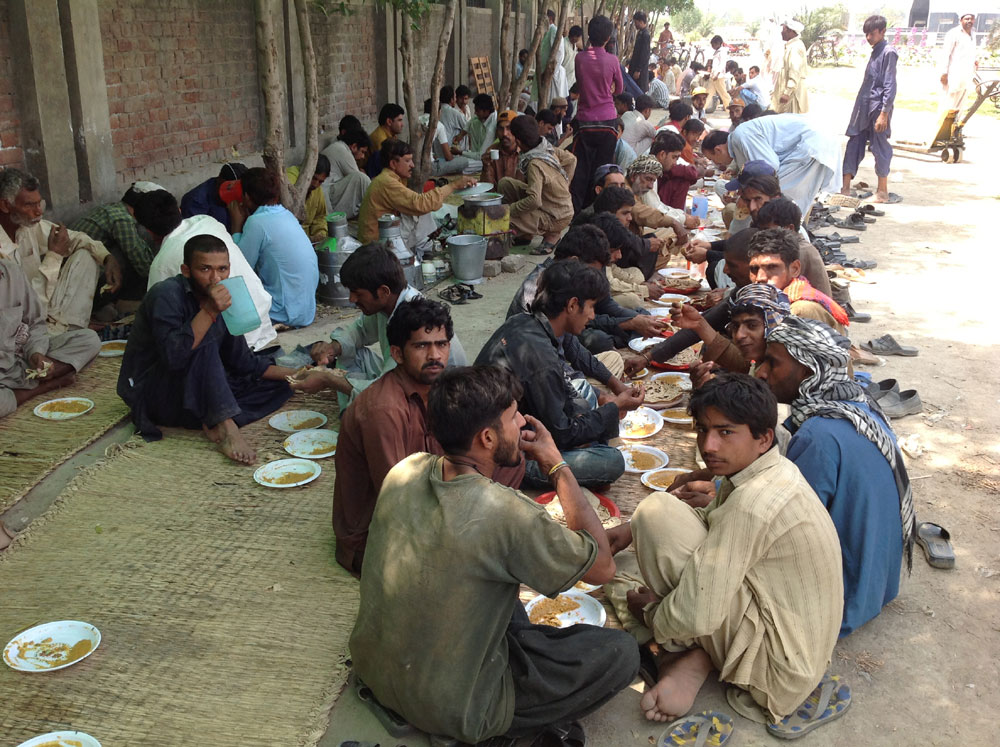
But the Gujjar is on the winning side of the estate game. It didn't take me long, however, to meet a loser. At first, I thought that he was from among the labourers; he was serving tea from his makeshift stall that consisted of a stove and a few pots. These labourers gather at the back gate of a factory that runs a free-lunch, langar, service – the local version of corporate social responsibility.
He told me that his family owned 25 acres in the area before the establishment of the industrial zone. Their land was force-evacuated and the price offered was too little. Then the cumbersome and corrupt system of payment, involving patwaris and others, made the amount so paltry that they had to look for other means to make a living. With hardly any educational qualification, the zamindar sahab ended up serving tea to poor laborers.
But Nisar Khan is a campaigner. He is talkative and articulate. He, along with the other affectees has approached many fora and all political leaders, staged protests and knocked at courts as well. Their politics moves solely around this issue.
The labourers who surround him are not interested in his politics. This is an alien country for them as they have migrated from far away areas looking for work. Some companies actually recruit labor from areas other than where their factory is located as a policy. A worker told me that some factories in the estate have blacklisted certain local villages and have placed notices on their gates to announce it, while others have instructed their suppliers to be mindful about this.
The employers find the locals quarrelsome and unreliable, while the captive migrated labourers are hardworking and their outputs can fit a decided schedule. So while the locals lost their prime possession, they now can't even avail the least lucrative of the new opportunities.
There are others who narrowly escaped the tragedy, as their land fell just outside the boundaries of the estate, and are now excited that the value of their land has skyrocketed. The increase, however, is imaginary and rarely translates into reality.