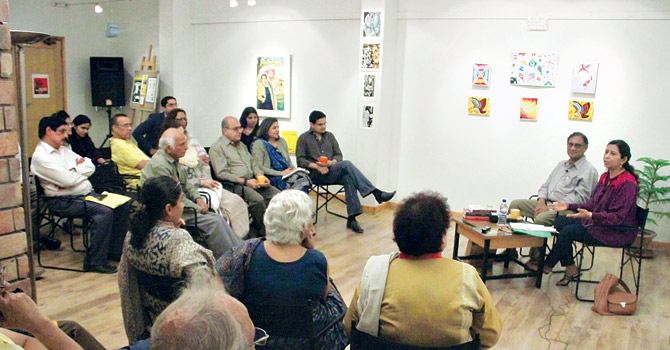
KARACHI: The culture and history of a city cannot have one definition, but it has many aspects all of which make it into a distinct entity, said noted literary critic Mehr Afshan Farooqi while talking about her forthcoming research project on the city of Allahabad during a conversation with Asif Farrukhi at T2F on Wednesday evening.
Ms Farooqi teaches Urdu and South Asian Literatures at the University of Virginia.
She interacted with the audience and posed a question to them as to what they understood by the word ‘city’. After receiving answers such as ‘people’, ‘architecture’, ‘languages’ etc she said a city had a multilingual identity.
Ms Farooqi then talked about how she thought of the project on Allahabad where she herself was born. She mentioned that Allahabad had a Muslim, Hindu as well as colonial past. Though people tried to change the name of the streets in the city, all street signage there was in English. The Mughals held sway over the city for long (Emperor Akbar made a fort along the bank of the Ganges) and things changed when the British took charge of India. Then the 1857 revolt, she said, caused the slumbering giant to wake up though the British didn’t let go of it.
Ms Farooqi said the city changed rapidly between 1858 and 1877. The British divided it into two. In 1888, she added, a university was established. Those who spoke the vernacular language lived on the older side of the city and those who could speak or had learnt to speak English lived on the other side. English suddenly assumed great importance and everybody scrambled to learn the language. Proficiency in English meant the acquisition of good jobs. As a result a community of Anglo-Indians began to develop.
Ms Farooqi said there were a high court and a railway station in the city therefore all kinds of people (Bengalis, Kashmiri pundits) rushed towards Allahabad bringing their distinct linguistic identities into the cultural mix, with the result that a particular kind of atmosphere was created.
With the passage of time, she said, the city also became a hub for intellectual pursuits.
Critic Mohammad Hasan Askari enrolled in the English department of the Allahabad University in 1938 and joined the already stellar group of Allahabad writers (Firaq, Amarnath Jha, Harivansh Rai Bachchan). She recalled that one of Askari sahib’s observations in an essay published in the journal Shabkhoon became the inspiration for her research. In that essay, which was printed in the form of a letter, Mr Askari had raised the question as to ‘what does one know about one’s own literature?’
Speaking about her other sources, she said she sought help from Harivansh Rai Bachchan’s autobiography and Sajjad Zaheer’s Roshnai. She highlighted the name of Prof Ajaz Husain, the focal point of whose work Meri Dunia was Allahabad. She said Prof Husain made an effort that the difference between the people belonging to two parts of the city (English-speaking and otherwise) was minimised. To counter the popularity of Friday Club (of literary gathering), he introduced Thursday Club.
Ms Farooqi said when Mr Askari was looking for a job, Shahid Ahmed Dehlvi offered him to write a column for his journal Saqi. The critic did that and named his column Jhalkian. She asked members of the audience about the meaning of the word jhalkian and received responses like ‘glimpses’ and ‘highlights’. She then explained herself that to her mind it was an extension of an image or impressions of what flowed through glimpses. Therefore all of that combined for her to be incorporated into her project, she added.
Ms Farooqi concluded that the city was a combination of subcultures of languages that fell into the neutral space of the English language. Her project was an attempt to see the bridges that joined all those cultures.
After her talk, Asif Farrukhi drew her attention to the fact that the picture of Allahabad that she had painted had a strong parallel with Karachi.