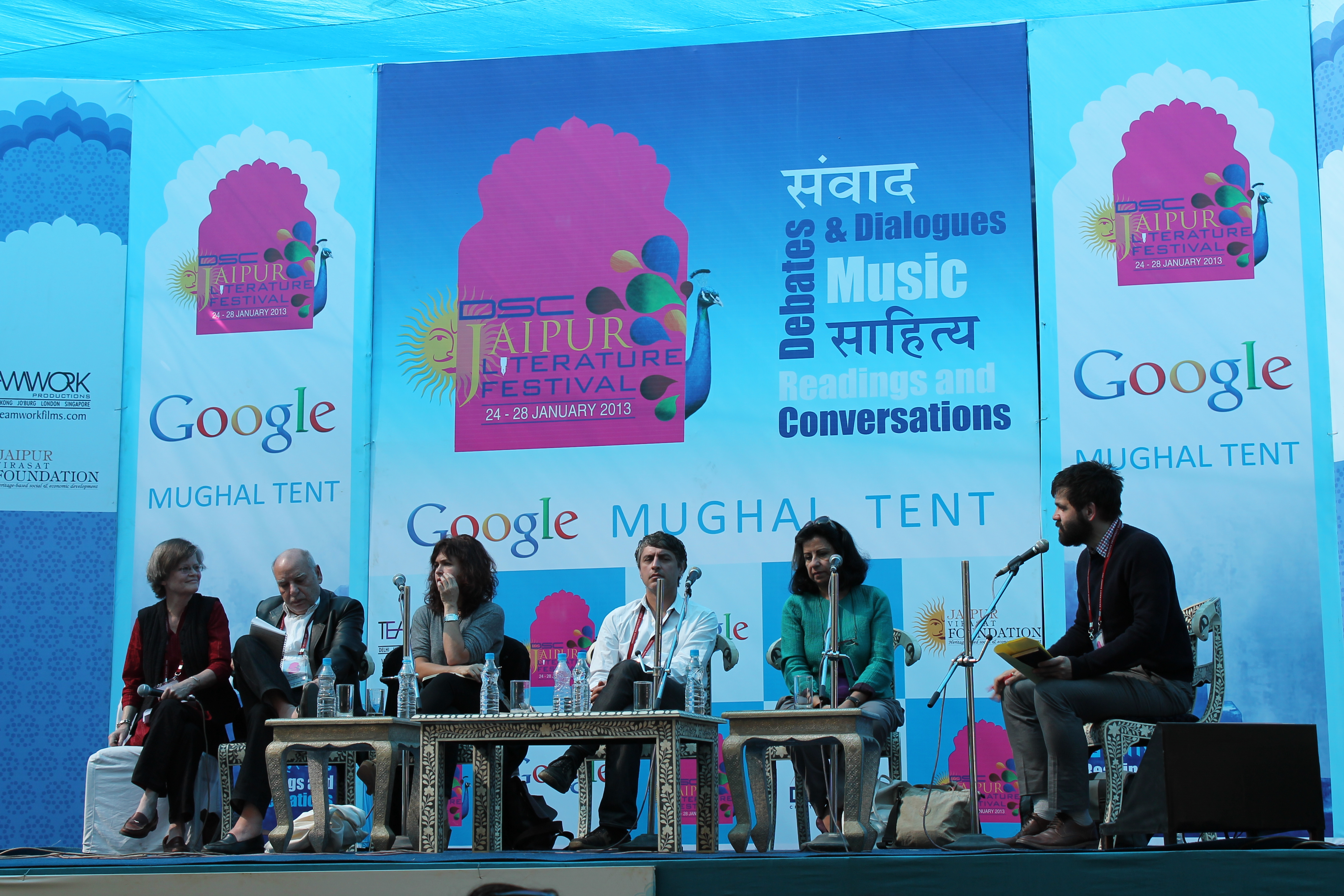
Just what is ‘Arabic’ literature, and is it even sensible or correct to categorise writing from so many different nations under one banner, asked the session “Maps of Love and Hate: Nationalism and Arab Literature”.
The panel of writers from different corners of the world was well qualified to offer their take: Tahar Ben Jelloun, the celebrated Moroccan-French writer, Ahdaf Soueif, an Egyptian writer, Selma Dabbagh, a British Palestinian, and Iranian-American writer Reza Aslan. This geographical spread made for a lively and interesting debate.
Is Arab literature just a conveniently named category in a bookshop, asked panel moderator Jonathan Shainan, who edits India’s Caravan magazine?
No, argued Ahdaf: “There is an Arab literature, which has been written from prehistoric times. It’s a literature that’s aware of itself as ‘Arab literature’,” she explained. Writers in Egypt are well aware of poetry in Morocco, and other Arab nations, she said as an example of this. However, the form of novel has been heavily influenced by the West. “The novel as an art form in Arabic was born from the novel in the West,” she said.
But in today’s globalised world, how do you define what Arab literature is, asked the panel?
Selma Dabbagh is the perfect example of a hybrid writer. She holds a British passport and writes in English, yet her subject matter is Arab issues. “The fault line depends on what you’re writing and what you’re concerned with,” she said.
Dabbagh argued that it would be refreshing if novels were categorised in ways other than by the nation state. For example, books written about families, being seen as ‘family’ books, rather than the critic digging further to discover the ethnicity of the writer.
This was a point further expanded by Jelloun, by far the most entertaining and humourous member of the panel. His words, and wit, stole the show. “You always write from the exterior,” he said, when asked about the sense of belonging a writer has to a nation, or language. “The writer is always in exile, even when he’s at home.”
“My homeland is my language and you’re allowed to have several homelands,” Jelloun continued, jokingly adding, “I’d love to be Indian also,” as the audience clapped in approval.
Jelloun argued that all too often Arab writers are expected to write about Arab problems and that the notion of one Arab world, writing one type of fiction, is unwieldy. “The Arab world doesn’t exist. There are so many countries, they’re not unified and they’re fighting each other. They have classical Arabic in common but most normal people don’t understand classical Arabic,” he said.
But for Ahdaf Soueif, there are some motifs which are common across Arab literature, and which can be found in the category. “One common theme is the fight against colonialism, which is a theme in the Arab novel.”
Yet Soueif cautioned against using too many measures to strictly define the genre, because any type of fiction could fit into any category. “The Mill on the Floss could be an Arab novel, or Middlemarch, if you say that they’re all about finding a voice or a place.” Ultimately, argued Soueif, Arab literature is about writing a good novel or poem, not about where it fits on a bookshop shelf, in a debate, or otherwise: “If you’re writing in Arabic or in an Arabic country, your primary concern isn’t about how your country is represented in the West.”
It was a sentiment echoed by Aslan, who said the focus of a writer is to tell stories, and that any agenda, or theme can get in the way. “Stories are about people, not events. The only thing that has the ability to break through what separates us, is story,” he said.
“If it breaks through, it doesn’t matter what God we pray to, or where we live.”