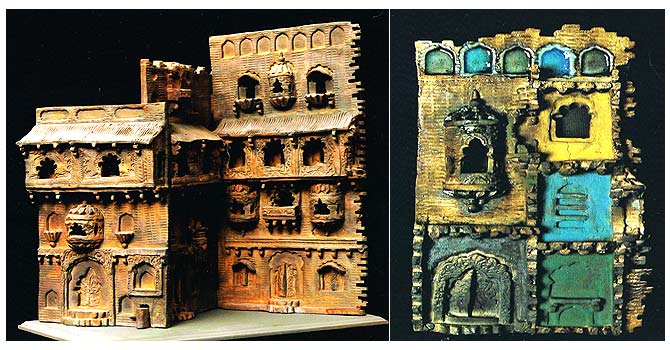
Jamil Hussain is a ceramist with a mission, and that plainly stated is to “conserve our built heritage.” His empathy with our ill-preserved and decaying architectural heritage is palpable in his ornate, richly patterned and textured creations in clay with which he attempts to preserve the image of our architecture of bygone days. The charming minarets, balconies, steep stairways and the intricately carved doors and windows — be it in reference to an old city bazaar in Lahore or a haveli in Aimanabad, are part of the aesthetic vocabulary which forms the narrative that ensues from his creative endeavour.
While the majority of ceramists tend to engage with forms alluding to items of utility, such as bowls, vases, plates and the like, occasionally creating wall panels particularly when commissioned to do so, Hussain’s interest is primarily to create three-dimensional architectural models. They serve not only as reminders of our rich heritage but can also be utilised as unique decorative objects in an interior.
Having viewed his work a couple of years ago and now comparing it with his recently exhibited creations which were showcased in Lahore’s Ze Grill Café and Gallery, it does appear reasonable to state that Hussain has developed a popular signature style. An element of repetitiveness is apparent nonetheless; there is also a visible urge to experiment and create new forms. Thus in some of the pieces, it seems as if the artist is trying to give life to the architecture — an expressionistic manner conveys a sense of agitation and distress which is invoked through the distortion of form.
The predicament in this, however, lies in maintaining the aesthetic value of the creations, which invariably comes out better in the more conventionally planned compositions. Perhaps, instead of distortion, further research on his chosen subject could help in bringing new forms and motifs to add variety as well as greater information regarding our endangered architectural heritage.
As of now, viewers can nonetheless, marvel at the intricate facades he creates, and the way texture, colour and form come together to create a mostly sumptuous visual and tangible experience. While burnished browns, terracotta and shades of gold predominate, exquisite greens, aquamarine and turquoise glazes are used in a number of works, adding to the visual beauty and richness.
Ceramics is a delicate art that requires more skill than envisaged by the layperson. The procedure involved in processing the clay and the expertise required for glazing and baking at the right temperatures all add up to the aesthetic considerations and the ideas the artist wishes to convey. In the creations of Hussain, all these come together quite admirably and one cannot but marvel at his expertise and dedication.
His initial training as a graphic designer has been channelised into a personalised medium, which seems to have stemmed from a desire to not only create objects with popular appeal but also to engage in an activity that is for him, a higher meaning and mission. Indeed our neglected heritage deserves better treatment than is being warranted to it and it is a pity to see that there are scant resources and an even scantier will to preserve them for posterity. Artists like Hussain are thus of special value, for at least a fraction of our ‘glorious past’ will have been safeguarded through them.