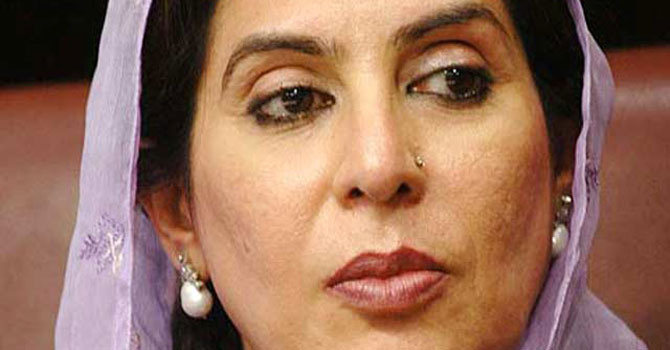
ISLAMABAD, May 13: The Speaker of the National Assembly, Dr Fehmida Mirza, is consulting constitutional experts, to seek their opinion about her role after the Supreme Court (SC) judgment against Prime Minister Yousuf Raza Gilani.
After hearing a detailed briefing on the court ruling from Law Minister Senator Farooq H. Naek, Dr Mirza met veteran constitutional expert and politician, former Chairman of the Senate, Wasim Sajjad, on Sunday.
“Yes, I have met Madam Speaker here on Sunday and discussed the legal issues that arise from the court ruling against the prime minister - and the possible role of the speaker’s office,” said Mr Sajjad, in an interview with Dawn. However, he refused to share details of his meeting with the speaker, saying, “From my end, this was a confidential meeting. Therefore, can’t tell you what legal issues were discussed, and what my opinion was.”
After the release of the detailed SC judgment on May 8 (which remained unclear on the prime minister’s legal status: i.e. whether he was automatically disqualified), the speaker’s office is in the limelight, with questions about its constitutional role.Moreover, on Friday, after the Islamabad High Court Judge, Justice Shaukat Aziz Siddiqui, said that the SC had not disqualified Mr Gilani as prime minister, the apex court “referred the matter to other constitutional forums”. Now everybody is looking to the Speaker of the National Assembly, Dr Mirza.
Dawn approached a senior PPP office-bearer with this information, and was informed that the party was working on a multi-pronged strategy to defend its convicted prime minister. Besides preparing a review petition against the decision that will be finalised after the prime minister’s arrival from the UK late on Sunday night, the speaker’s powers are also being explored.The PPP official said a favourable opinion on the issue of the speaker’s office would turn out to be an added advantage for the prime minister. The PPP official said the case had all the ingredients to become a long-drawn legal battle, which suited the ruling party.
Talking to Dawn, Chief Defence Counsel for the Prime Minister, Senator Aitzaz Ahsan, said he had until June 8 to file an appeal against the contempt decision, since its detailed ruling was released only on May 8. Reiterating his earlier position, Mr Ahsan said that since the bench, in its short order, convicted the prime minister for criminal charges that were never framed he ”considers the short order as a zero order”.
Explaining the role of the speaker’s office after the SC’s detailed judgment, another seasoned politician and constitutional expert, former Senator S.M. Zafar said that Dr Mirza had to give her opinion in the event that someone approached her and ask for her legal opinion.
Otherwise, the matter would automatically be transferred to the election commission.
“She can say that no question arises of the prime minister’s disqualification as a member of the house after the SC ruling, and forward her opinion to the election commission. In this case, the election commission will not have to proceed any further. But her opinion can be challenged in the SC,” said Mr Zafar.
Otherwise, if she believes a question of Mr Gilani’s disqualification arises following his conviction, she can ask the election commission for its judgment, which can lead to his de-seating from the house. But whatever she would note down, she would have to back it up with legal reasoning according to Mr Zafar.
Mr Zafar’s observation is in line with Article 63 (2) of the constitution, which says, “If any question arises whether a member of Majlis-e-Shoora (Parliament) has become disqualified from being a member, the Speaker or, as the case may be, the Chairman shall, unless he decides that no such question has arisen, refer the question to the Election Commission within thirty days and should he fail to do so within the aforesaid period it shall be deemed to have been referred to the Election Commission.”
Salman Akram Raja, another SC lawyer, said the constitution did provide the Speaker Office with a right to give its ruling when it comes to the question on whether a member of the National Assembly should continue working as legislator after being convicted.
However, Law Minister Senator Naek has repeatedly talked about the finality of the speaker office when it comes to the question of the prime minister’s membership in the National Assembly.
According to Mr Naek, only the Speaker National Assembly, as a custodian of the house, can decide the future of the prime minister - not the SC or the Election Commission of Pakistan. Their role, argued Mr Naek, only came into play if the Speaker Office refrained from deciding anything on the issue.
The main opposition party, the Pakistan Muslim League-Nawaz (PML-N), has refused to accept Mr Gilani as a lawful public office holder and is calling for his immediate resignation.