After a year, the trader returned to the forest as promised. But before the Jinni could slay him, three sheikhs appeared: one with a gazelle, the other with two dogs and the third with a mule. Their tales pleased the Jinni so much that he freed the merchant.
=============================
The tales we tell each other at this Virginia tavern appease no Jinni but they do allow us to relive our past, not just as it was but as we wanted it to be. This process is soothing, but like the puff of a joint it only brings temporary relief.Soon the Jinni returns brandishing his sword. For those born in a repressive society, it is not easy to get rid of this ghost. It remains with us, till the very end.
So the Ifrit we encountered back home, bore a hole into our souls and filled it with the fear of an impending doom. This fear is there, lurking, even when it isn’t baring its mythic fangs, waiting to leap from its inner lair and overpower us at the slightest excuse.
And the events of Sept. 11, 2011 provided ample opportunities to this Jinni to reappear. Had 9/11 happened in one of our countries, it could have led to riots and mass deportations. Thousands of Americans would have been killed in one day, their properties razed to ground and savings confiscated.
No mass killing happened in America. No burning, no looting. But 9/11 changed America forever. It is no longer as welcoming and free as it was before Sept. 11. Terror attacks that brought down the twin towers of New York also took away America’s soul.
Attacks on Muslims and Muslim-looking individuals, forced deportations, wiretapping, police surveillance of mosques and social groups had no place in pre-9/11 America. Now they are accepted as necessarily evils.
As I said before, all these allowed the Ifrit hiding inside us to jump out and bare its teeth – exacerbating the fear of doom that we brought with us from home. I experienced this on 9/11 when I saw armored personnel carriers on Washington’s streets. And when men in uniform stopped me near my office and asked for my ID. And again when a cyclist called my wife a terrorist because she was wearing shalwar-kameez.
This fear reared its head again when I visited New York soon after the terrorist attacks. I was on a Queens to Manhattan train. It was packed. No one was looking at me. I felt safe in the anonymity of the crowd. But my freedom from fear was short-lived.
At one of the stations, I don’t know which; a burly Caucasian boarded the train. Gen. George Patton’s philosophy glowered across his shirt – “The aim of the war is not to die for your country. It is to make the other b@*#d die for his.” He sat opposite me. Took out a newspaper and started doing a word puzzle. But soon put it away and started staring at me. First, I tried to ignore him but it was difficult to do so. I had no reason to believe he wanted to hurt me but my fear and guilt rose in my throat.
Confused and scared, I took out my cell phone – the train had not entered the tunnel yet. I called Raz, a friend in Brooklyn who had been beaten outside a bar near his flat several days earlier. Raz, almost a born socialist, found it funny he should be beaten up for being seen as an adherent of Islam.
I remember that in the early 1980s, when both the Islamic and Christian worlds were busy fighting a holy war against the Soviet invaders in Afghanistan, a group of Muslim zealots in Islamabad had set fire to Raz’s motorcycle because he opposed his country’s involvement in the Afghan jihad.
He has changed since then. After the collapse of the Soviet Union, he is not even a socialist. He moved to America soon after the Russians smashed his dreams of an ideal communist society and settled in New York.
“It is a city I respect,” he says of New York. “It allowed me to be lost in its madness. It is so big and so crowded that you can live here without being discovered by friends and foes. You even stop looking for yourself. It is a good feeling.”
Even two broken teeth, a fractured arm and bruised nose did not reduce his affection for New York. He still loves this city. But the beating had a strange impact on his relationship with his American girl friend.
Before the brawl, he loved undressing her and watching her white, unblemished body for hours. “It is flawless. No scar, no spot. Not even a mole,” he would say when asked what he admired in her. He insisted on undressing her after the beating too. But stopped there. They rarely made love.
Every evening he went home, finished his dinner, undressed his girlfriend and snuggled besides her like a child cuddling his mother.
“I feel protected,” he would say. This new twist in his love bothered his girlfriend, who wanted more than this display of childish affection. So they split. Raz is a polite man and tries not to annoy others. But soon after 9/11, he had a big fight with a mullah who stopped him near his flat, asking him to increase his contacts with his fellow Muslims.
“Why should I do that?” he asked the mullah.
“We should stay together. There is protection in unity,” said the mullah.
“Protection? What do you know about protection?” retorted Raz. “Have you ever slept next to a naked young woman? Nothing is more reassuring than a naked woman.”
This offended the mullah, who spread the news that Raz was now an infidel and “every Muslim who still values his faith should stay away from him.” The edict pleased Raz.
When I told him about the man on the metro and his shirt, Raz panicked. “Get off the train, take a cab and come over to me,” he said.
Our conversation broke off when the train entered the tunnel before Manhattan. I looked around for some reassurance; a friendly smile, a known face, a little affection. I found none.
As soon as I got off the train, my phone rang. It was Raz. “What happened? Why did you switch off the phone?” he asked.
“Nothing, buddy, I got disconnected.” I said.
“OK. But keep it on. I will keep checking,” he said. And he did. Several times.
I was already feeling better. It was a pleasant walk from Grand Central Station to UN Plaza. I passed and met people of every color and creed. I have always enjoyed this walk. But on this occasion, I liked it even more. It made me forget who I was.
This desire to assume a neutral identity that transcends all boundaries of color, caste and religion is not unique. We all yearn for a nameless and faceless identity whenever we are uncomfortable with our surroundings. New York is such an open and kind city that no individual or group feels out of place here. But after 9/11, we did feel that we were both an ethnic and a religious minority in New York. In some of us, this increased the desire to acquire a new name tag that could make us part of the larger crowd by erasing all those features that distinguish us from others.
But we also wanted to retain what we brought with us from home. We still do. We not only want to retain it but also want to pass it on to our coming generations.
This is a strange dilemma that perhaps all minorities have to face. Whenever they feel the crush, they regret being different from others and when they are among their own; they want to preserve what makes them different.
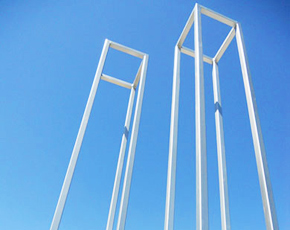
I looked back. There it was; the hollow that once rose into the sky, the twin towers of the World Trade Center. Nobody else in the van seemed to notice: The Guyanese driver talked into his cell phone; another New Yorker dozed. It was past midnight and we were returning to Queens after a late dinner in Manhattan.
The man next to me asked his friend if it was OK to smoke in the van. Two others were already chalking out plans for the next day. It was early November. Less than two months had passed since the city shuddered under its worst-ever disaster, but New York was moving apace.
This was my second visit to the city after 9/11. Unaffected by the madness of those who tried to derail this mother of all cities, New York was already rushing ahead to new horizons.
It had no time for the likes of me. I was ashamed of the tragedy brought about by my fellow Muslims and still reluctant to plunge into the mainstream, as I always did when I visited New York before 9/11.
But New York had no time for my guilt or fear. Earlier in the day, coming into Manhattan from Queens on the A train, I was once again in the grips of the fear that I developed during dawn-to-dusk curfews and midnight knocks that we experienced at home.
As I did during my first visit to New York after 9/11, I avoided eye contact with other passengers, hiding behind a newspaper. I soon realised my mistake – it was an Urdu newspaper. Although few in New York would know what Urdu was, many could distinctly see its Arabic script and identify me as one of “them.”
So I hastily fold back the newspaper and looked around me. I saw a left-behind copy of the New York Post and picked it up. I felt safe behind its Latin script.
A girl walked in wearing a hijab. She looked around and sat next to me. I said, “Salaam.” She smiled but did not respond. Was she nervous or was it me who was being hypersensitive? I don’t know.
The train now slid under the streets of Manhattan. A large group of Americans – mostly white men – entered, somehow increasing my fear and guilt. Some of them stood right in front of me. I looked for the Muslim girl. She had already gone. I was nervous.
The train passed through the stations where it once disgorged the World Trade Center commuters. I felt dizzy, as if something inside me had broken. I felt deformed. Incomplete.
I had this feeling again later at a bar. A girl was dancing like a cobra, a golden cobra. She moved her body to an invisible flute. Snake charmers waited on her, with their baskets wide open. But she slipped away, sinuously, and kept dancing with her eyes fixed on the invisible flute.
A man rose and held her in both his hands. She smiled and slipped out of his grip. I looked outside at a pale winter moon dwarfed by the neon lights.
Somebody came over and introduced himself. We talked about the weather, about why the winter was so mild this year. He changed the subject, but before he moves to the inevitable – 9/11 and its aftermath – I excused myself.
I went to the window and gazed at the moon, it was still pale and weak. A dog looked at it but did not howl. I wish he had. I would have felt better. But he suppressed his howl, looked at the moon again and walked away. I sighed but did not scream. I had wanted to scream for a long time, but I have held my silence.
Tension twisted me and I wanted to scream. I wanted to hold on to something. But all faces, all images were lost in the haze as I stretched my arms.
Shadows danced on the wall. Broad, bold shadows leapt in rhythmic chaos. They whispered to each other and laughed; a full-throated laughter filled the room, prickling my skin with fear.
An airplane flew over my head.
The familiar sight sent a shudder through my spine. I looked out the window again. The pale, blue moon was still there, hanging helplessly in the sky. The dog had gone. The golden cobra danced no more.
I was afraid to go out and face the hollow that once was the twin towers of the World Trade Center.