


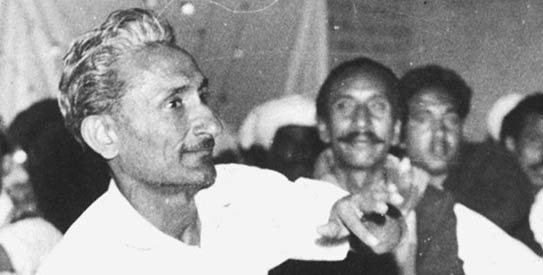
Celebrated 'gharra player' Mithha Khan Zardari, the man who with his intricate style of converting the earthen pitcher into a percussion instrument and earned laurels for the country all over the world, is dead.
Mithha Khan, recipient of many awards, passed away on Thursday, May 12, at his Nawabshah residence. He was 91.
Mithha Khan was born to a moderate village family in Sinjhoro taluka of Sanghar district. After his school education in his village and later at Naushahro Feroze madressah and Noor Mohammad High School in Hyderabad, he did his matriculation in 1942. He got a clerical job in the Sindh police from where he retired in 1980 after serving in many districts.
He developed a taste for gharra playing in his youth, learnt it with utmost care and played it first in family congregations and later at musical concerts.
He also played along with vocal maestros such as Sono Khan Baloch, Master Chandar and Jeevni Bai.
His performance at the annual Bhit Shah fair to the accompaniment of alghozo played by maestros Misri Khan Jamali and Khamiso Khan and as a soloist drew the attention of music-lovers and pilgrims.
Later, he performed regularly at Radio Pakistan and Pakistan Television.
During visits by foreign dignitaries, there would be no concert without the performance of Mithha Khan.
Aksi Mufti, who usually organised such concerts, would ensure that Mithha Khan was there and performed as the situation demanded. He was generally lauded by dignitaries, especially from the west.
The troupes the government used to send abroad included Mithha Khan. He performed in the United States, Germany, Britain, France and Scandinavian countries and won acclaim almost everywhere.
Unlike the western percussion, instrument ghaghar is played in the Subcontinent. In Karnataka, the ghaghar is made of copper creating lighter beat strokes.
In contrast, the earthen pitcher creates both the delicate sounds like tin, tik and kit while the hollow chamber creates sounds like jha, jhin, jhak. The earthen pitcher in Sindh played by Mithha Khan was wide-bodied with narrower chamber to produce the sounds the player wished.
In 1989, he won the Pride of Performance award.