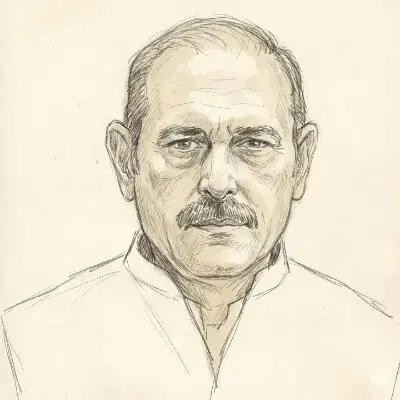
If there is one man who represents one of Pakistan’s biggest dilemmas, it is undoubtedly Baitullah Mehsud – militant commander from restive South Waziristan, who early this month took on the mantle of the chief of so-called Pakistani Taliban.
Little was known about this shadowy 32-year-old militant till October, 2004, and he was nowhere on the radar screen of Pakistan’s security establishment.
On the contrary, it was Abdullah Mehsud, his fellow Mehsud tribesman, who had burst onto the scene following the abduction of two Chinese engineers working at an irrigation project.
One of the Chinese engineers was freed while another was killed during a spectacular commando action.
It was this singular incident that would catapult Baitullah to the limelight and begin the downfall of Abdullah Mehsud – a college-educated Guantanamo returnee.
The tribal militants, who were battling the Pakistani troops, were somewhat piqued by the kidnapping of the Chinese.
The Afghan Taliban, who were in the process of organising themselves to fight in Afghanistan and were desperately trying to avoid a head-on confrontation with Pakistani forces in the tribal regions, were not pleased either.
Abdullah was made a deputy of Baitullah Mehsud and a shura was set up which further undermined his authority. It was said at the time that the Taliban preferred a cool-headed Baitullah over the temperamental Abdullah. Dejected, Abdullah left for Afghanistan to fight in Musa Qilla and was killed by security agencies in the Zhob area of Balochistan while returning home.
For almost three years now, Baitullah Mehsud has been the leading face of militant resistance whose influence, security official acknowledge, transcends the borders of South Waziristan. And its confirmation came, when militants from Pakistani tribal regions and some settled districts of the NWFP, unanimously decided to make him the head of Tehrik-i-Taliban, Pakistan, early this month. That the government had acknowledged Baitullah Mehsud as the new chief of militants in the Mehsud part of South Waziristan came in February, 2005, when it entered into an agreement with him in Sara Rogha following violent clashes and ambushes.
He pledged to cease attacks on security forces and government installations in return for a commitment by the government to withdraw forces from the Mehsud territory and not to take any punitive action against him and his associates.
This followed a brief lull in fighting, prompting the then corps commander, Peshawar, Lt-Gen Safdar, to declare Baitullah Mehsud a “soldier of peace” after a meeting with him at Jandola in August, 2005.
The meeting followed accusations by Baitullah Mehsud that the government was not honouring its commitments, was refusing to withdraw its forces and was continuing to attack his mujahideen.
Violence erupted again in the restive tribal region and a time came when the government’s writ was restricted to the compounds of the political administration.
Government officials claimed that Baitullah was running a number of training camps for militants and suicide bombers.
And in January this year, helicopter gunships targeted what the government claimed was a militant compound, killing 20 people.
Baitullah responded angrily and threatened revenge which he said “would be such that it would pain their heart”.
It was followed by a string of suicide attacks in Peshawar, Dera Ismail Khan and Islamabad.
By this time, government officials had begun pointing the accusing finger at Baitullah Mehsud. A UN report released in September blamed Baitullah for almost eighty per cent of suicide bombings in Afghanistan.
But emboldened by a relative peace in Wana, South Waziristan’s regional headquarters, following a tribal uprising to flush out foreign militants, the government made fresh overtures to Baitullah Mehsud.
Officials involved in behind-the-scene negotiations and some tribal interlocutors believed that Baitullah could be weaned away from violence by reviving the Sara Rogha agreement.
According to one senior official involved in the process, Baitullah was miffed that he was wrongly being blamed for all the suicide bombings and wanted a credible mechanism to investigate the real perpetrators.
And in a significant step, he fired a key lieutenant associated with the banned Lashkar-i-Jhangvi, who was widely believed to be behind most of the suicide bombings in the country.
But before such overtures could succeed, the government moved in fresh force and Baitullah accused the government of violating the terms of the peace agreement; the government insisted the troops were on their way to take ration and other logistics.
On August 31, Baitullah seized 242 soldiers and released them months later on November 4, a day after President Musharraf declared emergency in the country.
The release was made possible only when the government agreed to release 25 militants of the 30 militants in its custody, two of them would-be suicide bombers convicted by courts.
Officials involved in negotiations with Baituallah say he was not amused when the government backtracked on its commitment to release the remaining five men.
According to these officials, Bailullah had agreed to dismantle his training camps, expel foreign militants from his area, use his influence with militants to help the government restore order to some other tribal regions and some districts and put in place a mechanism to investigate allegations of his involvement in suicide bombings.
But, say these officials, the government’s refusal to set free the remaining five people, torpedoed the whole process.
As a protest, top administration officials in Fata secretariat, including the additional chief secretary and secretary security, proceeded on long leave, and were replaced soon by other officers. The political administrator, South Waziristan, the main character behind the failed overtures, has asked to be relieved, according to knowledgeable sources.
But there were some who maintain that the overtures were based on ‘over-optimism’ and that a committed Jihadi like Baituallah would never have agreed to the government terms.
While the government says it has solid evidence to prove Baitullah’s involvement in most of the suicide bombings, including the one which killed Benazir Bhutto, there are some who think that he has become a convenient scapegoat.
They say that the transcripts of a phone call offer little evidence of Baitullah’s direct involvement in Ms. Bhutto’s assassination. If anything, the transcripts, the authenticity of which has been questioned by the PPP, portrays a mysterious Maulavi Saheb as the main suspects. Clearly, Maulavi Saheb, according to these transcripts, happens to know more about the men involved in the assassination plot.
The government, according to some analysts, will have to make a more convincing case that the man it has been negotiating with until last month, was “an Al Qaeda leader” believed to be behind the assassination of the PPP chairperson.
Also, the assertion by the government that Baiullah was indeed the man responsible for Ms Bhutto’s murder would make it to face its own dilemma, yet again – an action it has been trying to avoid all this time – the implication any action against him on Pakistan’s own internal security environment.