• Trump says ‘toll’ will be replaced by trade & investment deals with Gulf states
• US forces carry out strikes against Iran for fourth day in a row
• Iran deputy FM says renewed US blockade ‘dismantles’ Islamabad MoU
• Tehran claims strike on US air base in Jordan
• Bahrain says it intercepted several Iranian aerial strikes
• Netanyahu warns Iran of decisive response if attacked
• China says US taking Mideast to ‘dangerous precipice’
TEHRAN: US forces carried out strikes against Iran for a fourth day in a row on Tuesday and reimposed a naval blockade to prevent ships from sailing to or from the country’s ports.
The military action came after US President Donald Trump backed down on his threat to heavily tax ships passing through the Strait of Hormuz, saying Gulf countries had agreed to make major investments in the United States.
US Central Command said the latest strikes were aimed at “degrading Iranian capabilities used to attack commercial shipping” in the strait, where Tehran has repeatedly carried out attacks on civilian vessels.
The renewed naval blockade came into force at 2000 GMT — an hour after the US strikes began — with a senior Iranian official saying the move effectively wrecked a deal struck with Washington to pause the conflict to allow peace talks to take place.
Deputy Foreign Minister Kazem Gharibabadi said US President Donald Trump’s decision to renew the blockade “has, in a way, dismantled the Islamabad memorandum”.
The United States has also issued new Iran-related sanctions and a general licence, according to details posted to the Treasury Department’s website.
Iran had earlier on Tuesday said a previous round of US strikes targeted its Gulf island of Qeshm in the Strait of Hormuz, the key shipping channel for Gulf oil and gas that has been largely blocked by Tehran since the start of the war.
Local authorities also said the US struck “four points” in Bushehr — which hosts Iran’s only civilian nuclear power plant — as well as an Iranian border area near Iraq and Kuwait.
Iran in turn hit two ships in Omani waters in the Strait of Hormuz, killing a crew member, according to the United Arab Emirates.
A Norwegian tanker was also hit by an explosion caused by an unidentified device off the Omani coast early Tuesday, the crisis response company MTI Network said.
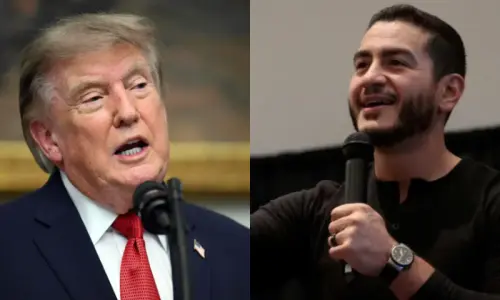
As attacks in the waterway continued, Trump said he was scrapping a planned levy on ships passing through it that he announced a day earlier, replacing the fee with trade deals with Gulf allies.
“I have decided to replace the 20 per cent United States Reimbursement Fee with Trade and Investment Deals that the various Gulf States will be making into the United States,” Trump said, in a post on his Truth Social network.
Meanwhile, India summoned Iran’s senior diplomat in New Delhi on Tuesday to protest against attacks on two commercial vessels in the Strait of Hormuz that killed an Indian seafarer and wounded several others.
Separately, the United Arab Emirates said on Tuesday that Iran attacked two ships in the Strait of Hormuz with missiles, killing one crew member and wounding eight.
Since last week, renewed US attacks have killed at least 28 people in Iran, according to an AFP tally based on Iranian media and official announcements.
After the strikes, Iran’s Revolutionary Guards announced they had in turn fired missiles and drones on Bahrain, targeting a residential building for US forces and other facilities.
Bahrain said it had intercepted “several treacherous aerial attacks launched by Iran” and accused Tehran of targeting civilians, after explosions and sirens were heard in Manama several times.
Washington has vehemently opposed Tehran’s desire to charge tolls in the strait, which international law generally forbids.
Oil prices had jumped more than five percent after the latest strikes, but later pared gains as Trump backpedalled on his proposed levy.
‘Decisive blow’
Tehran launched attacks on other US allies in the region, including Jordan, which said it had shot down four missiles from Iran.
Iran’s Revolutionary Guards said their strikes targeted US forces at an air base and urged Jordanians to issue a “serious demand for the removal of the occupying American bases from the region”.
Iran insists it only targets US interests in the Gulf, but its military command spokesman said any collaboration by Gulf countries with the United States would be considered “an act of war”.
Trump also threatened to destroy Pickaxe Mountain, a deeply buried nuclear site near Natanz where Western intelligence suspects Iran is building an undeclared enrichment facility.
“Tell the Iranians to be ready. Let them know we’re coming (and) there’s not a damn thing they can do about it,” he told conservative radio host Hugh Hewitt.
Earlier, US President Donald Trump said he gave Iran a chance and that they made a “big mistake” by firing first. “I gave them a chance. I wanted to give them a chance at making a deal,” he told reporters while hosting Iraqi Prime Minister Ali Ali-Zaidi at the White House. “Then, all of a sudden, they couldn’t do it, they didn’t like something about it.
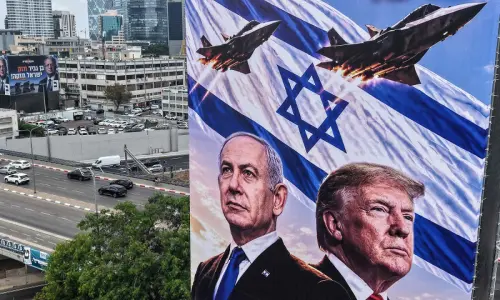
Israeli Prime Minister Benjamin Netanyahu warned Iranian leaders Tuesday that Israel would deal a heavy blow if they launched an attack on his country.
Speaking from Dimona, a southern town widely believed to house Israel’s undeclared nuclear arsenal, he told them: “Do not count on things remaining quiet if you attack us. The days are over when someone strikes us and we don’t hit back with a decisive blow.”
Meanwhile, China accused the United States at the United Nations on Tuesday of taking the Middle East to “a dangerous precipice” with its war against Iran.
During a debate on Yemen’s Houthi rebel group, China’s envoy to the UN, Sun Lei, said “the US has irrefutable responsibility over the current situation in Yemen and the Red Sea.”
Published in Dawn, July 15th, 2026