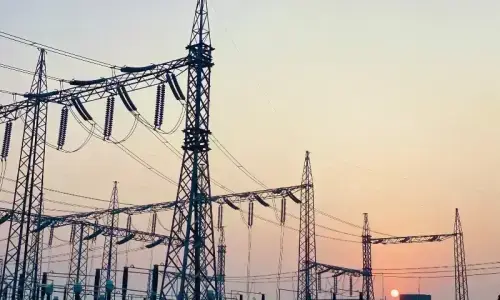
 THE response to recently advertised expression of interest (EOI) by the private power and infrastructure board (PPIB) for implementation of seven hydroelectric power projects has been overwhelming.
These raw-site projects, mainly large-scale, are to be implemented on international competitive bidding (ICB) basis, are located in the NWFP and Azad Jammu and Kashmir (AJK).
As many as 29 prospective investors have submitted detailed proposals. These include national companies and a host of investors from the USA, UK, Canada, UAE and China. These hydro power projects are:
Suki Kanari—capacity 655 mw— to be located on the Kunhar river, near Kaghan, district Mansehra;
Karrang—capacity 458 mw— to be set up in district Kohistan;
Madyan project—capacity 148 mw—- to be located near the River Swat;
Patrind —-capacity 130 MW—-on the Kunhar river in district Mansehra;,
Sharmal——capacity 115 mw —to be installed in district Dir;
Mahl—-capacity 245 mw—- on River Jhelum near Kohala, AJK and;
Harighel—-capacity 53 mw—- to be established near Bagh, AJK.
The proposals received from prospective investors are being evaluated by the PPIB for pre-qualification. Later, ranking of companies will be done for each project and letters of interest (LOI) will be issued to the selected by September/October 05.
This is for the first time that proposals for implementing hydro power projects have been invited under the Power Policy— 2002. Earlier, the PPIB has processed a number of projects under the Hydro Policy of 1995. In fact, the LOIs for 41 projects were issued and eventually the LOSs letters of support (LoS) were issued for 13 projects, of a cumulative capacity of 354 mw— four in the NWFP, five in the AJK and another four in Punjab.
Since its inception in 1994, the PPIB has successfully implemented more than 15 private sector power projects with a cumulative capacity of 5,577 mw, transforming the erstwhile government-monopolized power sector into a vibrant private-sector-led activity through introducing the independent power producers (IPP). Incidentally, all these projects are thermal oil-based and gas-based power plants and not a single hydropower project could be executed so far.
In all, proposals for setting up 39 hydro projects—varying from 10 mw to 960 mw capacity— have been entertained by the PPIB, at different times, from private sector on build-own-operate-transfer (BOOT) basis. The major projects include New Bong Escape hydropower project of 97 MW capacity, to be located about 7-1/2 km downstream of Mangla Dam, Kohala project of 600/740 mw and Abbasian project of 245 mw capacity, both proposed on the Jhelum river, Taunsa Barrage project of 120 mw on Indus river and Matiltan project to be located in district Swat having a capacity of 84 mw.
New Bong Escape Hydropower is the most promising project that may come up as the first hydropower IPP in the country. It is a run-of-the river, low head project, now scheduled to achieve financial close by October 2005. Its sponsors, Laraib Energy Ltd, have experienced tremendous difficulties in taking their project finally to this stage. They have been seriously working on this project since 1996 when initial project study was carried out. But it was only sometime in 2002 that a revised bankable feasibility report was prepared and approved.
The Power Purchase Agreement (PPA), though initialled in March 2003, was signed with the WAPDA”s NTDC (National Transmission and Dispatch Company) in April 2004, along with Implementation Agreement (IA) and Water Use Agreement (WUA) that had been initialled in December 2003. The project is expected to go into commercial operations within 36-42 months after the financial close, that is, earliest by December 2008, whereas it was to be commissioned by December 2005.
One may imagine the colossal loss, the nation suffered on account of inordinate delay in implementing only this project—concurrent loss of net 426 million kwh of electricity per year, and that too, relatively inexpensive electricity compared to thermal power generation. The position with regard to other projects is not different either. Balloki-Sulemanki Link (Tail) Canal hydropower project of 10 MW capacity is proposed to be located near Basirpur, district Okara.
This project was scheduled to achieve financial close by September 1998, but still there are no signs although negotiations for power purchase were initiated seven years ago. Likewise, the 84-mw Matiltan Project, proposed to be located on Ushu river, district Swat, was expected to be on stream by December 2005, but physical work has not yet been undertaken.
Power Policy—02 had envisaged commissioning of a total of nine hydroelectric power projects, in private as well as in public sector, with a cumulative capacity of 792 mw, during the five-year short-term plan. New Bong Escape, Malakand-III (81 mw) and Jinnah (on Indus river) of 96 mw capacity were scheduled for commissioning by December 2005. However, construction only on one scheme, Malakand-III project in the NWFP, has been undertaken by Sarhad Hydel Development Organization (SHYDO). It is not possible to commission the plant by December this year, which would be delayed by about a year. Another project of SHYDO, Pehur high-level canal project of 12 mw capacity was to be commissioned by December 2004. There is no physical progress on the project, as the government of the NWFP has not taken a decision to select engineering, procurement and construction (EPC) contractor as yet.
Likewise, Wapda’s five projects namely Allai Khwar (121 mw), Duber Khwar (130 mwW), Khan Khwar (72 mw), Jinnah (96 MW) and Golan Gol (mw) were to be commissioned by June 2006. While engineering, design and preliminary site work has commenced by the contractors/Wapda on the three Khwar projects, these are not expected to be completed on schedule. Likewise, the financial close of Jinnah project is awaited since long, while the fate of Golan Gol project is still uncertain. And there is no news about status of Mithankot (Punjab) project of 100 mw capacity that was to be commissioned by June 2007.
Currently, detailed feasibility studies are in advanced stage for many power projects, under the supervision of the PPIB, that are covered under the medium and long term plans as mentioned in the Power Policy 2002 document. These reports have been completed, in May 2005, for two hydel power projects in the AJK; Rajdhani project of 132 mw capacity at Mangla and Kotli project of 97 mw at Kotli, which were approved earlier as per Hydro Policy 1995.
Sponsors of the Kotli project are expected to commence negotiations for power purchase this year. Preparation of feasibility studies is in progress for Munda Dam project of 740 mw power generation capacity, Gabral-Kalam Of 101 mw, both proposed to be located in Swat. All the four projects are now scheduled to go on stream in the year 2009. However, the sponsors of Gulpur (Poonch, AJK) project of 60 MW capacity are to finalise project feasibility report by April 2007.
It is intriguing to observe that even Wapda, with all its financial, technical and human resources, is unable to achieve major progress and adhere to completion schedules that are covered under its over-publicized Vision 2025. As a natural course, the gas-based and oil-based power plants would need to be installed instead to meet the growing power demand. And that is exactly what is being done, much to the concern of all that are required to pay ever-increasing electricity tariff.
Delays have occurred due to failure to realize technical and economic challenges that a hydro power scheme poses to the investor and developer. In Pakistan, major hydro resources/sites are mainly located in the north, in the NWFP and Azad Jammu and Kashmir, primarily high head, run-of-river sites, with some as peak storage projects, whereas potential for small projects exists in the Northern Areas. These are far-flung and isolated areas, in high-altitude mountains, lacking basic infrastructural facilities required to develop such projects.
Road conditions are poor, as mostly non-metal and jeep-able roads exist unsuited to transport machinery and equipment. The sites are not easily accessible. There are other communication and logistic problems and limitations too, such as non-availability of labour, housing and open land for project as well as construction. Extreme weather conditions prevail in these areas. All these factors impede construction activities for the project, resulting in high capital cost and long construction time.
But the most important factor is that of the project feasibility. Though additional hydro potential is identified at 41,723 mw, there are hardly any detailed feasibility studies. Generally, these are just preliminary studies, not even pre-feasibility studies, which are based on reconnaissance data only for river flow. Detailed studies of topography, hydrology, site geology and engineering geological conditions are the basic ingredients to determine feasibility, or otherwise, of any hydroelectric power scheme.
The raw-site projects thus mean that the respective feasibility studies have not been conducted. Unfortunately, availability of reliable historical data, which include daily discharge, flood discharge over a period of years, volume of sediment carried by the river, etc., remains questionable in most of the cases.
Compliance of environmental requirements and resettlement are also of prime importance. Every hydel project is tailor-made, sometimes involving complex construction. For example, Karrang project (458 mw) entails an underground powerhouse and Neelum-Jhelum project (969 mw) requires a 35-km tunnel underwater. The design, engineering and construction of the project thus require special technology and expertise.
Undertaking detailed site investigations and preparing a bankable feasibility report of international standard requires placing substantial capital and other resources at risk. This investment is made without any guarantee that the project, if implemented, would meet commercial viability. Developing infrastructure and arranging for land lease could be expensive, time consuming and involving risks, giving nightmares at times to the investor. Wapda has faced difficulties in obtaining land lease for the on-going Khwar series projects located in Kohistan and Mansehra districts, resulting in delays in the construction of basic amenities for the contractors. These factors ultimately result in delays and cost overrun, besides the generation, and thus revenue, losses.
From the viewpoint of the investor, it is therefore vitally important that the related issues are addressed taking him into confidence, and the risks involved, are properly assessed and shared among various parties/stakeholders proportionately. For instance, the government may conduct detailed investigations and prepare feasibility studies for large-size hydro projects.
It will be attractive for the investor if the term of the PPA is increased from present 25-30 years to 40-50 years with a view to bring the levelized tariff to more acceptable level. There has to be some special fiscal and financial incentives too for setting up hydro power projects in private sector, and the processing time curtailed for signing the security package documents and approval of tariff by National Electric Power Regulatory Authority (NEPRA). The lowest tariff for the recently advertised hydro power projects will be determined on the basis of ICB. In case, the government adopts such measures, the power projects would be implemented as per scheduled programme.