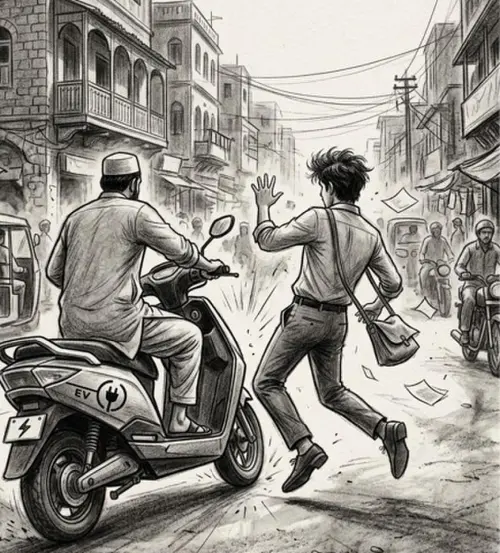
HAVING been trained in Hindustani classical music by his elders, Mehdi Hassan in the beginning had to work as a bicycle and auto-repair man to earn a livelihood. The family opted to move to Pakistan at the time of partition.
Here the music within Mehdi Hassan, which he breathed and lived, began to come out. He started to sing for Radio Pakistan and films. That was the humble beginning of a man on whose passing away his fans will mourn for a long time to come and remember him whenever his voice will be heard anywhere in the media.
One of Mehdi Hassan’s film-era songs is Hum Ko Gham Naheen Tha which was restricted to about three minutes. Later, he sang the ghazal in full classical style, enhancing its flavour all the more.
Mehdi Hassan had all the ingredients – complete knowledge of Hindustani classical music, a good knowledge of Urdu and a philosophical mind – to become the greatest ghazal singer of our time.
Perhaps, he got universal recognition from his extremely popular ghazal – Gulon may rung bharay, Muqaam Faiz koi raah mein jacha hee naheen, Jo koo-i-yaar se nikle to suay-i-daar chale written by Faiz.
Graduating from listening to film songs to ghazals, I first got a cassette of Mehdi Hassan in 1982. The 60-minute cassette had four ghazals. All four were sung in slow tempo with simple, easy-to-understand lyrics, nonetheless captivating. The one that I listened over and over again was Jab uss zulf ki baat chali, a 15-minute rendition like the others. That composition painted mesmerising imagery.
Thereafter, I started to acquire and listen to any and all cassettes and CDs that had the name Mehdi Hassan on it. It is, perhaps, because of Mehdi Hassan that I understand the rudiments of ghazal and Urdu poetry. In his concerts, time permitting, Mehdi Hassan would sing ghazals composed in various ragas. Ragas selected depending upon the time of the concert and suiting the audience’s mood. When Punjabis were in the audience, invariably there would be Heer. From the earlier three-minute format, some of his later ghazals would take up to 45 minutes. He kept the audience mesmerised every second of those long ghazals by interweaving his yarn of vocal sur and taan with ley, creating a multi-hue tapestry.
He performed worldwide from small private gatherings to large audiences. On many occasions, he entertained Kings in their palaces.
He sang with many different tabla players. He sang in his steady style unfazed, no matter how many variations and tempo the tabla player resorted to. Even if one did not understand the lyrics, one surely enjoyed the ragas and their nuances, and his coolly arriving at the sum of the tabla player.
He would be at ease singing late evening and night ragas like darbari and malkaus, effortlessly, as morning raga bairavi. He sang ghazals written by seventeenth century poets like Mir, Ghalib, Zauq to twenty first century poets like Qateel Shifai, Ahmad Faraz, Saleem Kauser and many others.
I have had the privilege of meeting Mehdi Hassan in several of his concerts. In every concert, the audience used to be multinational, including those who did not understand Urdu well.
Lata Mangeshkar regrets not having been able to sing a live duet with him, Tera milna bahaut achcha lagta hai, which he himself composed, that they intended to record. The duet, however, was completed later when both of them recorded their portion, independent of each other, which were superimposed.
Mehdi Hassan battled a long illness without much outside help. On his death, there are eulogies from many sections of society.
That ironically echoes the last misra of one of his great ghazals:
Baad marne ke mere qabar pe aaya woh Mir, yaad aaye mere insa ko dawa mere baad.
SURENDER CHIBBER India