KARACHI: The Pakistani rupee hit a record low of 89.45 per cent on Wednesday and has lost 4.3 per cent this year, after shedding 1.5 per cent in 2010.
With dwindling reserves, coupled with import payments, debt servicing and a lack of external aid, the pressure on the local currency is expected to continue.
Here are some questions and answers about the country's currency and its outlook:
WHY IS THERE PRESSURE ON THE RUPEE?
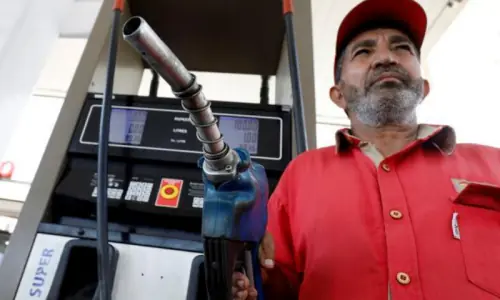
The main pressure on the rupee arises from oil imports which are paid for in US dollars, and make up about 40 per cent of the total import bill, which rose to $13.4 billion in the first four months of the 2011/12 fiscal year, compared with $10.88 billion in the same period last year. Oil imports rose to $5.27 billion from July-Oct, compared with $3.4 billion in the same period last year.
Analysts said the oil import bill is likely to grow because gas shortages will force factories to turn to oil for operations. Unless there is a sharp fall in international oil prices, which are now around $108 a barrel, the pressure is likely to continue.
HOW DOES THE CURRENT ACCOUNT AFFECT THE RUPEE?
The current account constitutes trade balance, interest and dividends, and foreign aid.
Pakistan's current account deficit for July-October widened to $1.555 billion, compared with $541 million in the same period last year.A widening current account deficit means that there are more dollar outflows, therefore increasing the demand for dollars. And when there is increased dollar demand, the rupee comes under pressure.
It can also lead to a balance of payments crisis, which is when a country does not have enough foreign exchange reserves to pay for imports and its debt repayments. Pakistan does not appear to be heading towards a crisis at the moment as it did in 2008 when it had to turn to the International Monetary Fund for an $11 billion loan programme.
Pakistan's foreign exchange reserves stood at $16.68 billion in the week ending December 2 which is enough for now. However, in the medium term, there is concern. Reserves have already fallen $1.63 billion since hitting a record high of $18.31 billion the week ending July 30.
WHAT HAPPENS IN THE SECOND HALF OF FY11/12?
Pakistan's loan programme with the IMF ended on Sept. 30, with $3 billion remaining undisbursed. It opted not to seek a new programme or ask for an extension. It has to make a large repayment of about more than $1.1 billion in the second half of 2011/12 fiscal year.
In 2012/13 it has to pay the IMF about $3.04 billion, 2013/14 $3.38 billion, 2014/15 $1.33 billion, and 2015/16 $61.2 million. These payments will balloon the current account deficit, which, coupled with the lack of external aid and rising imports, will likely depreciate the rupee further.
HOW DO US-PAKISTAN TENSIONS AFFECT THE RUPEE?
Washington is the biggest donor to Pakistan and has allocated some $20 billion in security and economic aid to Pakistan since 2001, much of it in the form of reimbursements for assistance in fighting militants.
However when there is a crisis in relations between the two nations, there is always a fear that the United States may cut off all aid. Two senior Republican senators recently called for a thorough review of US relations with Pakistan, declaring that all security and economic aid to Islamabad must be reconsidered.
There is also concern that foreign aid and international loans from other agencies and countries could dry up because of tensions in US-Pakistan relations. Any decrease in external financing could grow the current account deficit, which would further weaken the rupee.
HOW DOES MONETARY POLICY FIT IN? Since July the State Bank of Pakistan has cut its key policy rate by 200 basis points to 12 per cent to spur economic growth.
It kept it flat November 30, however, when it announced its monetary policy for December and January. Analysts said the 200 basis points cut has been a factor in the depreciation of the rupee.
OUTLOOK FOR RUPEE (TO DOLLAR):
Brokerage June 30, 2012 Optimus Capital Management 91 AKD Securities 91.5 Invest Capital Investment Bank 92 Topline Securities 92 Global Securities 91.5-92