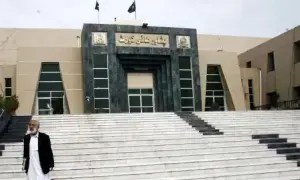
ISLAMABAD: The Supreme Court decided on Tuesday to dedicate the next hearing on missing persons’ case to the grant of subsistence allowance to the affected families.
A Supreme Court bench, headed by Justice Javed Iqbal, also indicated that it would hear the cases of people who had gone missing after the Lal Musjid operation in Islamabad at the next hearing on June 27.
At the last hearing on May 19, the government had submitted a proposal to provide a maximum of Rs60,000 to each family, but Additional Attorney General K.K. Agha admitted that the amount was not sufficient. “That is why the interior ministry requested the government to allow enough supplementary grants so that families which really suffered because of disappearance of their breadwinners could be provided with enough subsistence on the basis of needs after thoroughly reviewing their cases,” he had said. On Tuesday, Ms Zainab, the mother of Faisal Faraz who had disappeared several years ago, rejected the government’s proposal and said all she wanted was his son and not compensation. “We will eat grass but will not accept compensation from the government,” she said.
Zahida Parveen, a mother who had allegedly lost her son 32 months ago to a group of militant women recruiting teenagers in Islamabad, threatened to commit suicide if she failed to get him back.
Justice Iqbal advised her not to lose hope, saying that she would soon meet her son.
He said the issue of missing persons had become a chronic problem and, therefore, the Commission of Inquiry on Enforced Disappearances, constituted on the orders of the apex court, should be made permanent. He asked the government to appoint its head within two days.
The court was not happy with the performance of the Foreign Office as well as the interior ministry when it was told that a number of Pakistanis were still languishing in prisons of different foreign countries on petty crimes and merely because they failed to pay fines.
The bench deplored that exaggerated figures of missing persons were presented in the court, especially of those who had been missing in Balochistan.
Justice Iqbal observed that different NGOs working in the province claimed thousands of people had disappeared, but the commission on missing persons was seized with only 100 cases. He said the court was not sitting here to fulfil objectives of the NGOs.