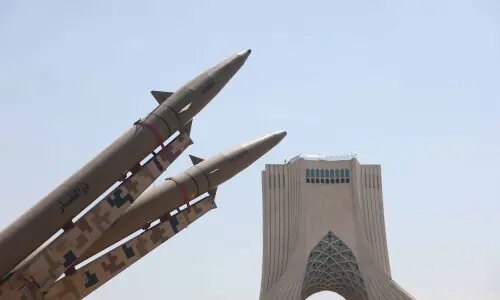
WASHINGTON, Jan 25: Pakistan’s nuclear and missile programmes are not consistent with its friendship with the United States, says a proposed US legislation (partly reported in Thursday’s Dawn), which was recently adopted by the House of Representatives.
Diplomatic circles in Washington feel that the proposed law, now before the US Senate, can lead to new controversies over Pakistan’s nuclear programme.
Some US lawmakers had recently demanded a congressional inquiry into the activities of the so-called A. Q. Khan network of proliferators.
Most of these lawmakers were from the Democratic Party, which now controls both chambers of the Congress.
Pakistan cooperated with the United States and other Western powers in unearthing the network on Washington’s assurance that if it helped undo the ring, Islamabad will not be blamed for the activities of an individual.
But the Implementation of 9/11 Commission Recommendations Act reopens the question of Pakistan’s nuclear and missile programmes in a manner that is bound to worry Islamabad.
In a sub-section titled `Finding’, the proposed act notes: “Congress finds that Pakistan's maintenance of a network for the proliferation of nuclear and missile technologies would be inconsistent with Pakistan being considered an ally of the United States.”
Sub-section 2, titled `Sense of Congress’, adds: “It is the sense of Congress that the national security interest of the United States will be best served if the United States develops and implements a long-term strategy to improve the United States relationship with Pakistan and works with the Government of Pakistan to stop nuclear proliferation.”
Pakistani diplomats in Washington, however, point out that the proposed law is non-binding and will not lead to a suspension of US military assistance to Pakistan.
They also hope that the Senate version of the proposed law will be more `friendly’ and will consider Pakistan’s interests as well.
Pakistan’s ambassador Mahmud Ali Durrani has already been meeting senior US senators to convey Islamabad’s views on the issue.
GENERAL ELECTION: Another provision of the proposed law is more worrying for the government than the country. It binds the extension of waivers from the suggested prohibitions on US military assistance to the conduct of the general election in Pakistan.
The portion dealing with the prohibitions calls for stopping US military assistance to Pakistan if Islamabad fails to halt the resurgence of Taliban inside its territory.
The US president, however, may waive the limitation on assistance for a fiscal year if he determines and certifies to the appropriate congressional committees that it is important to the national security interest of the United States to do so.
But the section on democracy adds a condition to this waiver as well. The section says: “It is the sense of Congress that determinations to provide extensions of waivers of foreign assistance prohibitions with respect to Pakistan … for fiscal years … should be informed by the pace of democratic reform, extension of the rule of law, and the conduct of the parliamentary elections currently scheduled for 2007 in Pakistan.”
Pakistani diplomats feel that while the Senate may soften some aspects of this bill, the provision for certification will remain. Every time the US president sends to Congress a request for providing military assistance to Pakistan, he will have to certify that Islamabad is doing its part in combating the Taliban and restoring democracy.