UN body moves Indian Supreme Court against contentious citizenship law


United Nations High Commissioner for Human Rights Michelle Bachelet has filed an intervention application in the Indian Supreme Court against the Citizenship Amendment Act (CAA), the Indian Ministry for External Affairs said on Tuesday.
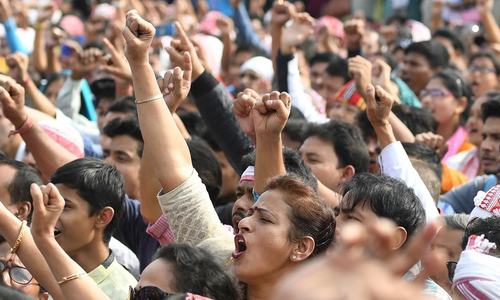
The petition by the United Nations came amid ongoing protests in India against the CAA — which was enacted in December last year. The protests took a turn for the worst last week in Delhi, where over 40 people were killed in communal violence in various parts of the city.
“Our Permanent Mission in Geneva was informed yesterday evening by the UN High Commissioner for Human Rights that her office had filed an Intervention Application in the Supreme Court of India in respect to CAA,” India's External Affairs Ministry spokesperson Raveesh Kumar said in a four-point statement.
In his response to the application, Kumar said the citizenship law is an internal matter of India "and concerns the sovereign right of the Indian Parliament to make laws".
He further said that the Indian government "strongly believes" that no foreign party has the capacity to call for an action on issues pertaining to India's sovereignty.
He further said that the CAA meets all requirements of India's constitution and thus is constitutionally valid. “It is reflective of our long-standing national commitment in respect of human rights issues arising from the tragedy of the Partition of India,” he said.
“India is a democratic country governed by the rule of law," the spokesperson said while adding that the country has "utmost respect for and full trust in our independent judiciary".
He said that the government is confident that their "sound and legally sustainable" position will be proved right by the Indian Supreme Court.
Last week, Bachelet had also expressed concern over police inaction during the communal violence that took place in the Indian capital. Then too, the Indian government had said that the CAA was an internal matter of India.
Last year, at the 42nd session of the council in Geneva, Bachelet had said she was "deeply concerned" after India initiated its clampdown in occupied Kashmir.
India's move to annex Jammu and Kashmir through revocation of the region's special status and imposition of a communications and travel lockdown was also strongly criticised by independent UN experts who termed the moves as "collective punishment" for the entire population.
An earlier version of this article incorrectly referred to Michelle Bachelet as the United Nations High Commissioner for Refugees. The error is regretted.