ISLAMABAD: The army said on Tuesday that action against Mumbai attack accused Hafiz Saeed and his organisations — Jamaatud Dawa (JuD) and Falah-i-Insaaniat Foundation — followed a policy decision by state institutions.
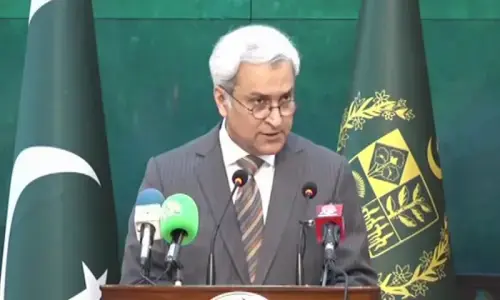
“It was a policy decision taken by state institutions keeping in view the national interest,” military spokesman Maj Gen Asif Ghafoor said at his first press conference while answering a question about detention of Hafiz Saeed and four others a day earlier under a legal provision — Section 11-EEEE of the Anti-Terrorism Act 1997 that allows the government to keep terrorism suspects in custody for 90 days.
The ISPR chief said the army would give precedence to the national interest and extend full support to other state institutions for serving it.
Military spokesman warns public debate on ‘sensitive issues’ can create gulf between state institutions
The press conference was held hours after Army Chief Gen Qamar Bajwa met Prime Minister Nawaz Sharif to discuss what was described by the PM Office as matters relating to “regional and national security”. The action initiated by the government against the JuD leader was reportedly discussed during the meeting.
The JuD chief had earlier been put under house arrest in December 2008 following the Mumbai attack and remained under detention till June 2009. The official line ever since has been that Hafiz Saeed had not been involved in any illegal action within the country and criticism of inaction against him was rebuffed.
Hafiz Saeed has been listed as a terrorist by both the United States and the United Nations for years. In 2012, the US announced a $10 million bounty for information leading to his arrest. However, the Pakistan government had then not taken any action against JuD or Falah-i-Insaaniat Foundation and Hafiz Saeed freely held rallies in support of his organisations’ objectives and for fund-raising.
It has been a subject of intense speculation as to what prompted the government to finally act against Hafiz Saeed and his organisations and how credible were those measures.
Maj Gen Ghafoor denied that the action was taken under international pressure. “Independent countries take their decisions according to their national interest.”
But he parried a question about what made the ‘state institutions’ realise that cracking down on Hafiz Saeed now suited Pakistani interests.
He said that more details about action against Hafiz Saeed and his organisations would become public over the next few days.
Word of caution
The military spokesman cautioned against public debate, which he dubbed “speculation” on “sensitive issues”, saying it could create a gulf between state institutions.
He was reiterating what a press release issued by the Inter-Services Public Relations in response to the media controversy over the allotment of land of former army chief retired Gen Raheel Sharif said: “This debate with intent of maligning the army also has the potential to create misunderstandings between state institutions thus considered detrimental to existing cohesion.”
Gen Ghafoor’s reference was apparently to both the land allotment row and various other controversies related to the military that keep surfacing on the media.
“We firmly believe that our defense, security, development and prosperity were deeply linked to harmony and strengthening of institutions,” he said, adding: “The country can only develop if we remain united for the bigger objectives of defeating terrorism and for progress and prosperity.”
In reply to a question about the inquiry into a Dawn story about a security meeting, the military spokesman said the outcome of the investigation was expected in a few days. He said the findings of the inquiry commission set up by the government would be shared with the media.
Published in Dawn, February 1st, 2017