Fresh horror in Mediterranean as another 100 migrants feared drowned
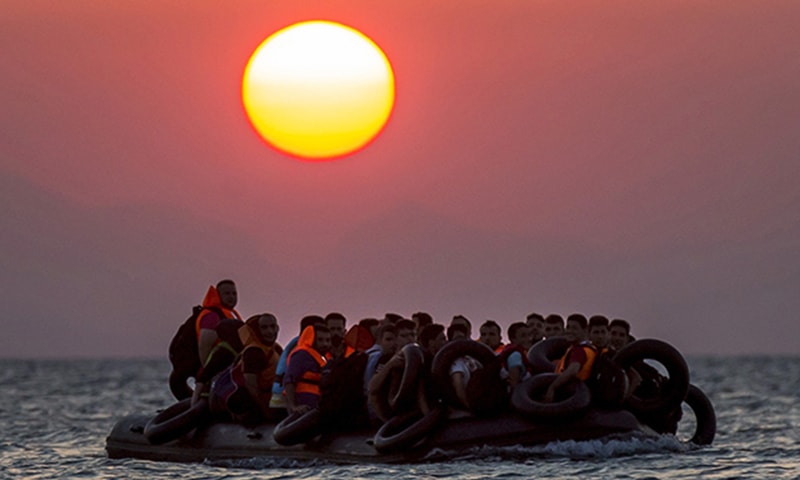


ROME: A hundred migrants were feared drowned on Thursday after yet another migrant shipwreck off the Libyan coast, raising the number of those missing feared drowned this week to 340.
Doctors Without Borders (MSF) said around 100 people were believed to have drowned in the Mediterranean on Wednesday, according to 27 migrants who had been plucked to safety and were being brought to Italy.
The surviving group, all men, said they had set sail from a beach close to Tripoli before dawn on Monday. After several hours the traffickers travelling with them aboard a separate boat took their engine and left them to their fate, without a satellite phone to call for help.
The overcrowded dinghy began rapidly taking on water and deflated. Tossed for two days and nights on rough seas, some passengers fell overboard, while others succumbed to exhaustion.
By the time the British military ship Enterprise — engaged in the anti-trafficking Sofia operation — found them, they discovered just 27 people alive, clinging to what was left of the dinghy.
Once rescued by the Enterprise the migrants, who come from Gambia, Guinea, Mali, Senegal and Sierra Leone, were transferred to the MSF’s Bourbon Argos, along with six bodies retrieved from around the dinghy.
“They are exhausted, shocked and traumatised,” MSF coordinator Michele Delaro told this news agency by telephone from aboard the Bourbon Argos, which had returned to the rescue zone off Libya after disembarking nearly 800 migrants in Sicily a few days earlier.
The shipwreck was just the latest in a series of tragedies this week: on Monday, 15 people were rescued from a dinghy that had been carrying some 150 people, while on Tuesday 23 were found on another boat that initially had 122 aboard.
Rescuers had pulled nine bodies from the wateron on Wednesday and spotted a 10th but were unable to recover it.
The first 15 survivors were brought to Catania and spoke of their battles to hold on to anything that floated as their dinghy sank.
The 23 people rescued on Tuesday were transferred to the Aquarius, charted by SOS Mediterranee and MSF, and expected to arrive in the port of Reggio Calabria on Italy’s mainland on Friday.
“They are mostly traumatised and suffering from anxiety attacks,” said Mathilde Auvillain, a spokeswoman for SOS Mediterranee.
“One young boy has been weeping, asking for his mother. Another has written a list of names of the people travelling with him and re-reads it over and over. He wants to know if his friends are on the boat or in the sea,” she said.
Over 3,200 people have been rescued from crowded and unseaworthy dinghies since Saturday, according to the Italian coast guard.
The total is the same as for the whole month of November 2015 and, following a record number of arrivals in October, shows departures from Libya are not being deterred by worsening weather in the Mediterranean.
Published in Dawn, November 18th, 2016