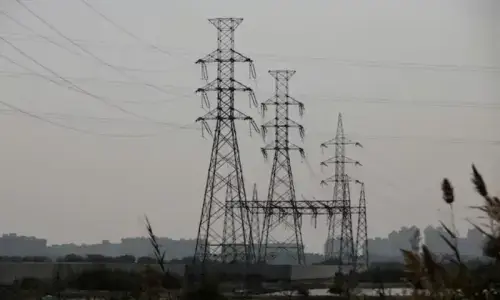
KARACHI: Historian Gul Hasan Kalamati gave the people of Karachi a lot to think about on Saturday evening when he said that water and electricity meant for Karachi were being redirected to Bahria Town and DHA City.
Mr Kalamati was one of the many speakers invited by the Irtiqa Institute of Social Science to talk on the military farms in Okara and the Bahria Town.
The title of the meeting was ‘Snatching from the needy to give to the greedy: a meeting to condemn atrocities committed by the government by dispossessing people from their centuries old tenantship/ownership’.
Mr Kalamati said that the people living in these gated communities might never suffer from water shortages or loadshedding while the situation in Karachi would just become unbearable.
According to Mr Kalamati, who is also a representative of the Karachi Indigenous Rights Alliance (KIRA), it is important for people to understand what real estate tycoons, builders and construction companies are doing.
He said that it was difficult to get people to work with them as many were afraid of what could happen.
“We might have had this realisation late but at least we did realise what was going on — and that Bahria was a fraud,” he said, adding that he started KIRA along with a few like-minded people a year and a half ago to create public awareness and fight back.
Mr Kalamati compared the Bahria Town to the East India Company.
Fahim Zaman, an activist and former administrator of the KMC, spoke extensively on the land acquisition act, regularisation of goths and the Goth Abad Scheme, according to which goths and villages which have been registered cannot be sold or given away.
He said that was what Orangi Pilot Project’s Perween Rahman had been working on when she was shot dead in March 2013.
Dr Bakshal Thalo of the Awami Workers Party discussed military farms in Okara and their legality.
He linked his conversation to the state and how it had the monopoly.
He said that most people accepted the state narrative and it was difficult to establish an alternative narrative.
He added that due to the threat of evacuation, people in Okara were working together for their rights.
Human Rights Commission of Pakistan’s Asad Butt, Kabir Khan of the Rakhazamat Wala Bacho Committee and Dr Azra Talat of Roots for Equality also spoke at the event.
Published in Dawn, April 24th, 2016