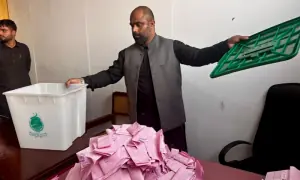
Anyone trying to understand the local government elections system in Sindh — whose first phase gets under way on Oct 31 — is most likely to get lost in a complicated haze of wards, union councils, and municipal corporations, some of which will have direct elections while others indirect. Here Hasan Mansoor explains key terms and the entire process.
Q: What is a town committee?
A: A town committee governs a small town with a population of up to 50,000. It is composed of wards or union committees where every voter casts a single vote to directly elect a town councillor.
Q: What is a municipal committee?
A: A municipal committee is a higher tier than the town committee with a population of more than 50,000 and up to 300,000. Just like a town committee, a municipal committee is composed of wards and its voter also casts a single vote to directly elect a municipal councillor.
A union committee is composed of four wards, each represented by a general member and known as general councillors, along with a chairman and a vice chairman. They are all also directly elected.
Q: What is the difference between a union council and a union committee?
A: Both are territorial units and their composition is the same. However, the key difference between the two is that a union council is in a rural area whereas a union committee is in an urban area.
A union council is composed of a chairman, a vice chairman, four general councillors and one district councillor — all directly elected. The district councillors thus elected from each union council go to the district council.
Q: What are municipal corporations?
A: There are three municipal corporations in Sindh: Hyderabad, Sukkur and Larkana. All the directly elected chairmen of union committees become members of the municipal corporation. They then elect members on reserved seats and next elect mayors and deputy mayors — this entire exercise is an indirect election process.
Q: What are district municipal corporations (DMCs) and the metropolitan corporation?
A: Both of these are Karachi-specific. Karachi has six districts and there are as many DMCs and. It has a single metropolitan corporation known as the Karachi Metropolitan Corporation.
The vice chairmen are directly elected in union committees and these vice chairmen become DMC members of their respective districts. DMC members will elect members on reserved seats and then elect chairmen and vice chairmen in each of their DMCs.
The chairmen of the union committees are directly elected and become members of the metropolitan corporation. They then elect a mayor and a deputy mayor.
Published in Dawn, October 30th, 2015
On a mobile phone? Get the Dawn Mobile App: Apple Store | Google Play