WASHINGTON: A reverse faulting at immediate depths about 210 km below the Hindu Kush Range in north-eastern Afghanistan caused Monday’s earthquake in the Pak-Afghan region, according to the US Geological Survey.
In a report on the earthquake and its causes, the USGS said the rupture occurred on either a near-vertical reverse fault or a shallowly dipping thrust fault. At the latitude of the earthquake, the Sub-continent moves northward and collides with Eurasia at a velocity of about 37 millimetres per year.
Active faults and their resultant earthquakes in northern Pakistan and adjacent parts of India and Afghanistan are the direct result of convergence between the South Asian and Eurasia plates.
This collision causes an uplift that produces the highest mountain peaks in the world like the Himalayas, the Karakoram, the Pamir and the Hindu Kush ranges.

Earthquakes such as this event, with focal depths between 70 and 300 km, are commonly termed “intermediate-depth” earthquakes. Intermediate-depth earthquakes represent deformation within sub-ducted lithosphere rather than at the shallow plate interfaces between sub-ducting and overriding tectonic plates.
Active faults and resultant earthquakes in Pakistan, India and Afghanistan are the result of convergence between the S. Asian and Eurasia plates
They typically cause less damage on the ground surface above their foci than is the case with similar magnitude shallow-focus earthquakes, but large intermediate-depth earthquakes may be felt at great distance from their epicenters.
Pakistan is located in the Indus-Tsangpo Suture Zone, which is roughly 200 km north of the Himalaya Front and is defined by an exposed ophiolite chain along its southern margin. This region has the highest rates of seismicity and largest earthquakes in the Himalaya region, caused mainly by movement on thrust faults.

Examples of significant earthquakes, in this densely populated region, caused by reverse slip movement include an 8.1 magnitude earthquake in Bihar, the 1905 7.5 magnitude Kangra and the 2005 7.6 magnitude Kashmir earthquakes.
The latter two resulted in the highest death tolls for Himalaya earthquakes seen to date, together killing over 100,000 people and leaving millions homeless. The largest instrumentally recorded Himalaya earthquake occurred on Aug 15, 1950, in Assam, eastern India. This 8.6 magnitude right-lateral, strike-slip, earthquake was widely felt over a broad area of central Asia, causing extensive damage to villages in the epicentral region.
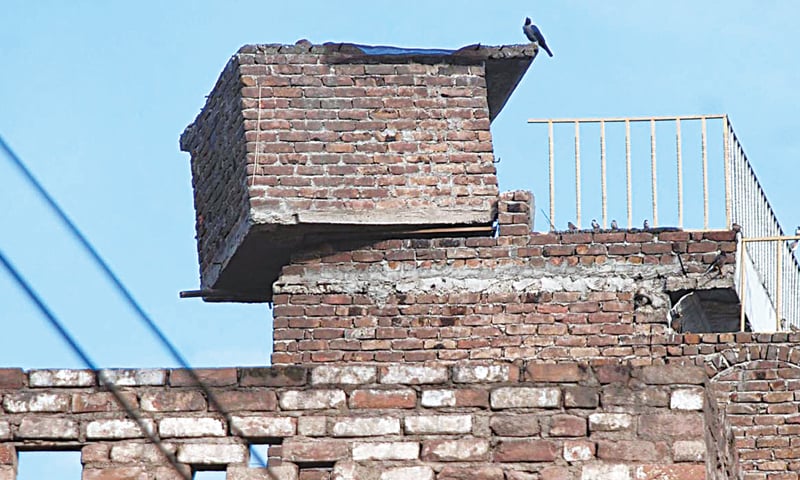
Along the western margin of the Tibetan Plateau, in the vicinity of south-eastern Afghanistan and western Pakistan, the South Asian plate translates obliquely relative to the Eurasia plate, resulting in a complex fold-and-thrust belt known as the Sulaiman Range. Faulting in this region includes strike-slip, reverse-slip and oblique-slip motion and often results in shallow, destructive earthquakes.
The May 30,1935, 7.6 magnitude Quetta earthquake, which occurred in the Sulaiman Range in Pakistan, killed between 30,000 and 60,000 people.
Published in Dawn, October 27th, 2015
On a mobile phone? Get the Dawn Mobile App: Apple Store | Google Play