PAKISTAN Steel Mills, the country’s largest industrial complex, is again on the priority list for privatisation, with the transaction scheduled to be finalised by the end of December. Road shows have already been conducted in China and will be followed in Russia in a couple of weeks.
The previous attempt to sell Pakistan Steel Mills (PSM) by then-Prime Minister Shaukat Aziz to a Saudi-led consortium for Rs21.6bn ($362m) was struck down by the landmark Supreme Court decision of June 2006, which practically led to the freezing of the entire privatisation programme for almost eight years.
A subsequent court decision required fresh approval for the mills’ privatisation by its board of directors and the Council of Common Interests.
PSM’s accumulated losses and liabilities, which stood at Rs26bn at end-2008, have now increased to about Rs350bn, including Rs160bn in losses and Rs190bn in payable debt liabilities. In addition, the government has injected over Rs85bn out of the federal budget in different bailout packages.
“The present state of PSM is due to unchecked corruption, inefficiency, over-employment and the government’s lukewarm attitude towards its revival,” summarised a report to the Economic Coordination Committee by the secretary of the industries ministry.
This has been reinforced by a financial adviser (FA) — the Pak- China Investment Bank, partially assisted by China’s Sinosteel — which has concluded that the PSM has been bestowed with all the business opportunities and potential that a regional industrial unit can wish for. As they say, there is nothing wrong with the machine but the man behind it. The plant has been closed since June 10.
The FA has told the government that with a capital expenditure of $886m — which should be injected by the new buyer in three phases — as well as uninterrupted power supply and the replacement of the mills’ current unsuitable management, the PSM has the location, market, facilities and the potential to become profitable.
In its 165-page report on the transaction structure for PSM’s sale, the FA has proposed a three-stage development and expansion plan with a capital investment of $288.77m in the first phase to revive the existing unit and to achieve a capacity utilisation of 1.1m tonnes per annum.
This will be followed by an investment of $300.4m in the second phase to expand the annual production capacity to 2m tonnes, and of $296.62m in the third phase to increase the capacity to 3m tonnes.
“The way for PSM to achieve three-phased transformation and revitalisation is through privatisation, the formation of a new management team, and overall optimisation of the supply chain,” said the FA. It recommended that the mills’ management control be handed over to the new buyer along with a minimum of 51pc shares.
The PSM’s “current management team is not suitable for the three-stage transformation. To participate in market competition, the buyers shall set up new management and technical teams to take full control of PSM’s operations and management,” it said.
It recommended the government — as the unit’s equity partner — to continue its tax policy and other support to aid the mills’ recovery and development and strengthen its product quality and standards.
On the basis of field surveys, extensive data and in-depth discussions, the adviser concluded that PSM “is a steel enterprise that has a high starting point, complete process chain and the advantages of resource acquisition and regional market”.
It said PSM has rare logistic cost advantages given that it is located near the country’s largest city as well as Port Qasim, which reduces the transportation cost for its imported raw materials and fuel.
Meanwhile, the country’s steel consumption has a considerable growth potential as it currently depends on 40pc imports. Some factors that are expected to aid the industry’s future growth include a large population; per capita GDP of just over $1,000; the setting up of residential and commercial structures fuelled by a growing national economy; and infrastructure development courtesy the upcoming China-Pakistan Economic Corridor projects.
The PSM has the quality advantage, as the quality of steel products of a large number of domestic small electric furnace mills and independent steel rolling plants is said to be poor.
Besides, the PSM — being the only combined process large-scale iron and steel manufacturer in the country — will have the government’s support (including through tariff barriers on steel imports), which will protect the local enterprise from cheap foreign steel.
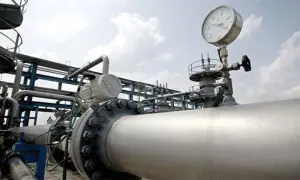
But the report added that the mills’ main equipment is outdated and has been out of repair; its control system is completely paralysed; and its sinter machine, blast furnace and continuous casting equipment are all either close to or have exceeded their respective designed lives.
Since 2008-09, the complex has faced seven consecutive years of losses, which now amount to 87pc of its total assets. Around 79pc of the mills’ assets are in the shape of land, while its liabilities exceed its assets, turning its equity negative. The FA valued the company’s assets at Rs280bn by March, against its then-liabilities of Rs174bn.
Latest: The Cabinet Committee on Privatisation decided last Friday to offer the PSM to the Sindh government which had earlier conveyed its interest to aquire the mills.
Published in Dawn, Business & Finance weekly, October 5th , 2015
On a mobile phone? Get the Dawn Mobile App: Apple Store | Google Play