ISLAMABAD: Of the nearly 72 organisations and outfits that have been declared ‘proscribed’, only a handful are likely to face action in the coming days as part of the government’s impending crackdown on terrorists and militant groups, sources in the interior ministry told Dawn.
The sources say that the government’s focus, at least in the initial stages, would be on organisations which had taken up arms against the state. Such organisations will not be allowed to operate on Pakistani soil anymore and members of such groups who are known to be involved in violent activities will be arrested, an official in the interior ministry told Dawn.
“Following their arrest and interrogation, such individuals will be produced before military courts for trial under a defined procedure,” he said.
The official confirmed that groups which had claimed responsibility for recent terrorist attacks would be proceeded against, but refused to give any details.
He said the provinces had been asked to develop a “multi-faceted process of scrutiny” whereby cases would be sent to military courts, adding that the methodology would be fine-tuned by his ministry.
Benign groups?
It is believed that most banned organisations do not have militant wings and the ministry has no plans to act against such groups. In addition, the ministry’s official said, it was ‘not advisable’ to simultaneously act against all banned outfits.
The provinces had been asked to identify outlawed outfits and keep an eye on key operatives. They will also be looking into groups that have re-emerged under different names after their original incarnation was banned by the government.
The official told Dawn that individuals who faced criminal charges under the fourth schedule of the Anti-Terrorism Act would be monitored closely. Under the law, he added, such persons were supposed to report to a police station before travelling to any other city, as well as intimating their date of return. He said such people were also required to report to the police station concerned in the city they are travelling to, but admitted that this provision had scarcely been enforced in the past.
Although he did not offer specifics on which organisations were regarded as being an immediate threat, the official said a comprehensive assessment was being carried out to ascertain how many of the 72 were active and how many were operating under changed names.
The National Counter-Terrorism Authority’s National Coordinator Hamid Ali Khan could not be contacted to get his point of view.
The government’s list features organisations such as Al Qaeda, the Tehreek-i-Taliban Pakistan, and some of its factions, including the Tehreek-i-Taliban Bajaur, Tehreek-i-Taliban Mohmand and Tehreek-i-Taliban Swat. Then there are organisations whose names reflect their inherently militant nature, such as the Balochistan Liberation Army, Balochistan Republican Army, Balochistan United Army, United Baloch Army, Balochistan Bunyad Parast Army, the 313 Brigade and the Abdullah Azzam brigade, among others.
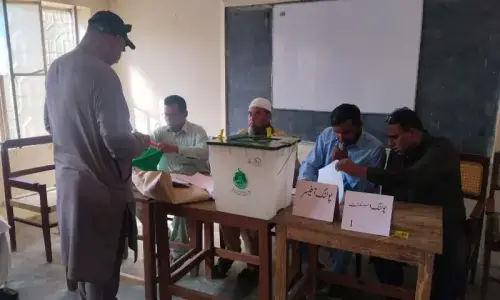
When asked about banned outfits that had taken part in the last general elections, he said a new procedure was being devised for registration of political parties.
At least 40 candidates from the outlawed Ahle Sunnat Wal Jamaat, including its chief, Ahmad Ludhianvi, had taken part in the 2013 general elections.
Former Punjab law minister Rana Sanaullah met Ludhianvi more than once prior to the 2013 elections and justified his meetings by saying that members of the Jamaatud Dawa and Sipah-i-Sahaba Pakistan were not terrorists.
However, the official avoided commenting on political parties which were said to have links with banned outfits.
In June 2010, Ludhianvi even claimed that at least 25 PPP MNAs had won the 2008 general elections with his party’s support.
Published in Dawn, January 11th, 2015
On a mobile phone? Get the Dawn Mobile App: Apple Store | Google Play