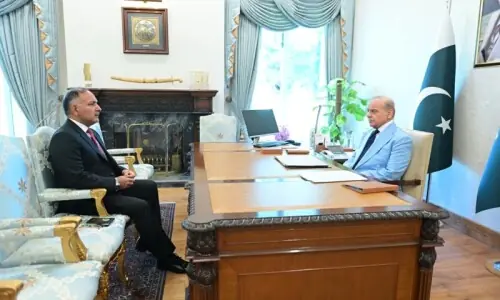
ISLAMABAD: Prime Minister Nawaz Sharif met President Mamnoon Hussain on Thursday to discuss the execution of prisoners who had been awarded the death penalty, following the withdrawal of a moratorium on execution.
“Both leaders decided that no mercy will be extended to any convict on death row,” a source privy to the meeting said.
Read: Nawaz removes moratorium on death penalty
The official told Dawn: “It was decided that the government will not prioritise the GSP Plus status, which had been awarded to Pakistan by the European Union in return for keeping the moratorium in place.”
A spokesperson for the president said Mamnoon Hussain had asked PM Sharif to involve non-political religious scholars to contact militants and convince them to give up their ‘un-Islamic’ and ‘inhuman’ agenda.
During the meeting, the PM briefed the president on the Peshawar tragedy and the outcome of the multi-party conference held in Peshawar a day earlier.
Also read: Militant siege of Peshawar school ends, 141 killed
“The prime minister told the president that political parties had unanimously committed to eliminating the scourge of militancy and extremism from the country,” he said.
The president welcomed the consensus and said that this demonstrated the unflinching determination of the Pakistani nation to thwart the nefarious designs of anti-state elements.
Sources also said that a proposal to constitute speedy trial courts also came under discussion on Thursday.
Procedure
Talking to Dawn, the PM’s adviser Barrister Zafarullah said that it took at least 14 days to execute a convict once death warrants were issued.
Farooq Adil, a senior official at the Presidency, explaining the procedure of approval of a death warrant, said that the summary was initiated by the interior ministry and was sent to the Presidency through the PM’s Office. Then, they are sent back through the same channel, so that the interior ministry could issue the warrants.
Retired Justice Tariq Mehmood told Dawn that once a death warrant was issued, it was sent to the relevant trial court, which referred it to the relevant prison authorities. They, in turn, inform the families of the condemned men and give them a chance for a final meeting before the sentence is carried out.
Published in Dawn, December 19th, 2014