

ISLAMABAD: Although the law-enforcement agencies in Lahore busted a sectarian group this week, it is still not clear if this indicates a change of strategy on the part of Punjab government, which until now has turned a blind eye to militant activity in the province despite worrying reports and assessments.
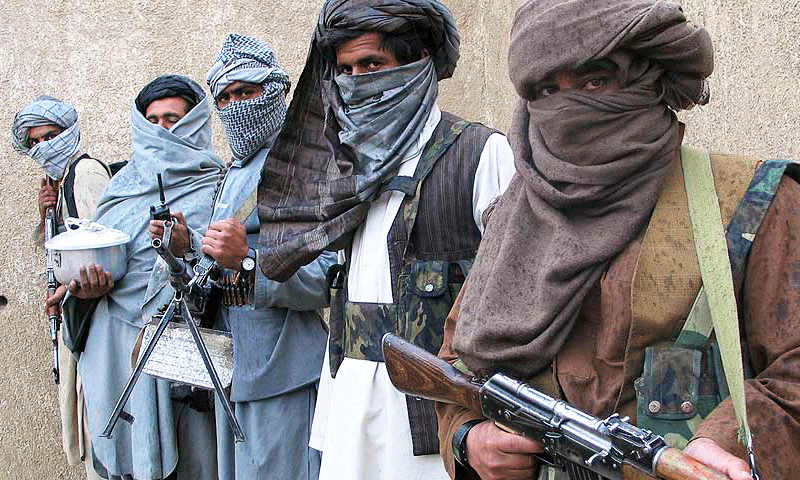
Senior officials point out that the Punjab government has been “sleeping over” regular reports being sent to them by intelligence agencies about the increasing presence of sleeper cells of proscribed militant organisations.
More than one intelligence official involved in the preparation of these reports told Dawn that Prime Minister Nawaz Sharif and Chief Minister Shahbaz Sharif were aware of the militant threat present in Punjab, but they were not taking strict measures to counter them.
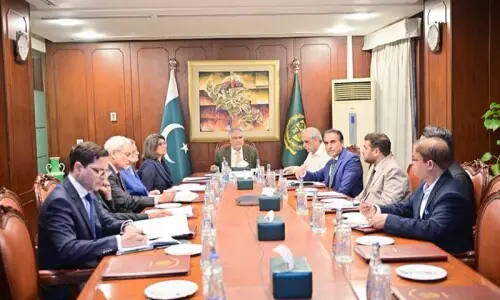
The threat has now become so serious that on April 12, the chief minister held an emergency meeting at Lahore airport soon after returning from China.
The meeting was held primarily due to the threatening calls received by a Lahore-based businessman. He had been asked to cough up money and in order to prove that the threats were real, cracker bombs had been set off at his home and office.
Pervez Malik, an MNA from the PML-N, was present at the meeting. “Since I am in touch with the Lahore-based business community, I was specially invited to attend the meeting. It is a serious matter.”
However, Mr Malik disagreed with the perception that the Punjab government had been soft on the operatives of banned organisations carrying out militant activities in the province.
“The very fact that the chief minister held a special meeting within minutes of returning to Pakistan shows the seriousness of the provincial government.”
He told Dawn that callers were using different telephone Sims from locations across Pak-Afghan border. Elaborating, he said that those who had threatened the businessman had gathered information about his office and home and other details, which showed that they had operatives working on the ground in Lahore.
However, Mr Malik added that the threatening phone calls had been traced to Afghanistan; this, the parliamentarian pointed out, showed the reach of the terrorist networks.
Lahore has also been witness to a number of sectarian attacks, which it was revealed on Friday were carried out by the group that was busted.
The attacks on television anchor Raza Rumi and writer Asghar Nadeem Syed are cases in point.
When asked about the allegations that the PML-N was more concerned about the development and security of Lahore city which was why it was unwilling to take on the militants in Punjab, Mr Malik insisted that the chief minister was paying special attention to the southern parts of the province.
“One can regularly see him visiting these areas.”
Mr Malik added that “unfortunately, militancy has spread all over the country, but the PML-N has to be given credit as Punjab has remained comparatively safe from terrorism.”
Mr Malik’s claims notwithstanding, the intelligence agencies take a less rosy view of what the Punjab government is doing.
According to the intelligence officials, the provincial government only reacts to terrorist attacks after they happen in what can be called an ad hoc manner; it has no long-term counter-terrorism strategy.
Specific incidents are investigated, its culprits are traced but this can be called a reactive policy at best. “Whenever there is a meeting on security, the chief minister and other officials of his government acknowledge that sleeper cells of armed militants are now entrenched in Lahore and the rest of the province. However, this discussion does not lead to a consensus on taking concrete steps,” remarked an official of a federal intelligence agency.
He pointed out that South Punjab was already home to Lashkar-e-Jhangvi, Sipah-i-Sahaba and Lashkar-e-Taiba. But of late their presence in central and northern Punjab towns has also been noticed and the information conveyed to the provincial government.
“The most worrisome part is their ability to carry out armed operations in the upper part of the province.”
In response to a query, a senior official of the federal government told Dawn that the interior ministry was concentrating on the Karachi operation and talks with the Tehreek-i-Taliban Pakistan (TTP); it was not pursuing the militants’ presence in Punjab.
Under the new internal security policy, Chaudhry Nisar Ali Khan’s ministry has been given the central role of gathering intelligence and following up on reports and recommendations.