0
0

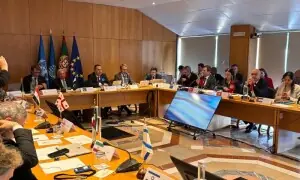
WASHINGTON: The United States and Pakistan emphasised the need for moving their relationship from aid to trade as they resumed their strategic dialogue here on Monday after a three-year gap.
Pakistan, however, appeared more cautious than the United States in rebuilding a relationship which has deteriorated rapidly since May 2011, when Osama bin Laden was discovered and eliminated in Abbottabad.
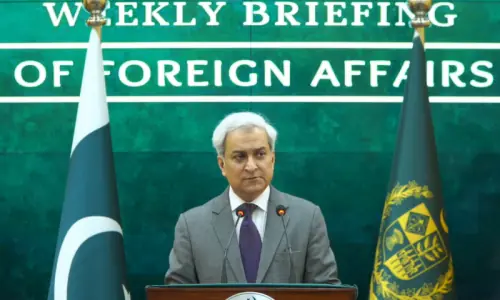
In his opening remarks, Adviser on National Security and Foreign Affairs Sartaj Aziz stressed the need for transforming the post-2014 US-Pakistan transactional relationship into a strategic partnership, but noted that this exercise had an “overbearing and sobering background”.
US Secretary of State John Kerry, who began his remarks with “As-Salaamo Alaikum to our friends from Pakistan”, was more positive and spoke enthusiastically about the US desire to leave behind the tensions of the recent past and focus on what laid ahead.
“We fully support Prime Minister Nawaz Sharif’s goal of making Pakistan's marketplace a tiger economy for the 21st century,” he said. “Indeed, greater trade and investment between the United States and Pakistan will make both of our countries more prosperous.”
Mr Aziz is leading a high-power delegation which includes Defence Minister Khawaja Asif, Chief of General Staff Lt-Gen Ishfaq Nadeem Ahmad and Ambassador Jalil Abbas Jilani.
The American side, led by Secretary Kerry, includes Special Representative for Pakistan and Afghanistan James Dobbins and US Ambassador to Pakistan Richard Olson.
Mr Aziz said that since August 2013, when Secretary Kerry announced the plan for reviving the strategic dialogue process, he had been “thinking as hard as I could … at what stage a normal or transactional relationship becomes strategic?”
The most important pre-requisite for a strategic partnership, he said, was “mutual trust at all levels and among all key institutions”.
The second most important element from Pakistan’s perspective was “the expectation that the US will not look at Pakistan from the two specific lenses of Afghanistan or terrorism”, said Mr Aziz.
Legitimate US concerns on Afghanistan, he said, “must be balanced by giving due importance to Pakistan's own security concerns” and by giving a “careful attention to the long-term effects” of US policies on Pakistan.
“I am sure, most of you will agree that historically, Pakistan's security concerns were not taken into account when the US decided to withdraw from Afghanistan in the early 1990s after the defeat of the Soviet forces with
Pakistan's active support, or when it invaded Afghanistan after 9/11,” he said.
Mr Aziz said there was also a strong perception in Pakistan that “while a lot of pressure is exerted on Pakistan on issues of concerns to India, our legitimate concerns are not conveyed to India with the same intensity.”
One such concern, he pointed out, was the Kashmir dispute which has strained relations between the two South Asian neighbours since their independence from Britain more than 66 years ago.
“The overwhelming majority of the people in Pakistan support the normalisation of our relations with India and believe that the resolution of the Kashmir dispute would result in achieving this goal,” Mr Aziz said.
“If these important pre-requisites are met, then the contribution of other elements of this important relationship such as expanded trade, higher level of private investment, long-term partnership on some major projects, will become far more significant and mutually reinforcing,” he said.
Secretary Kerry, however, preferred to highlight “vital shared strategic interests” of the two countries, reminding Pakistanis that the US wanted to see their country “at the centre of an economically diverse region and a dynamic South Asian marketplace”.
The two countries had “a common cause and a common obligation to be partners for one another's prosperity in the fight against those who want to limit opportunity and take Pakistan backwards”, he said.
That’s why it was essential for the United States and Pakistan to continue to find avenues of cooperation on counter-terrorism and nuclear security, said Mr Kerry.
“We recognise that Pakistan is a vital partner in supporting a secure Afghanistan. And we know how closely Pakistan's own security is linked to Afghanistan's success. That's why addressing the threats posed to both Pakistan and Afghanistan by cross-border militancy is a key aspect of our conversations this week.”
Mr Aziz noted that the ongoing drawdown of Isaf forces in Afghanistan created both “new challenges and new opportunities” for cooperation between the US and Pakistan.
In pursuing this goal of a responsible end to the long war in Afghanistan, they have to ensure that Afghanistan successfully transitions into a period of stability and that past mistakes are not repeated, he said.
“Pakistan is very keen to work together with the US and with other countries in the region to encourage an Afghan-led reconciliation process for a peaceful and stable Afghanistan,” he added.
Secretary Kerry said the reinvigoration of the Strategic Dialogue was “an important symbol of our strengthening ties across a broad spectrum of our mutual interests”.Where the two countries have difference, they “pledge to work through them as friends and partners do in an effort to make our relationship stronger and more open for the long- term”, he said.
Mr Kerry praised the prime minister’s efforts to reinvigorate Pakistan's economy: “The US has no doubt that Prime Minister Sharif's policies will put Pakistan on a path towards a more prosperous future,” he said.