0
0
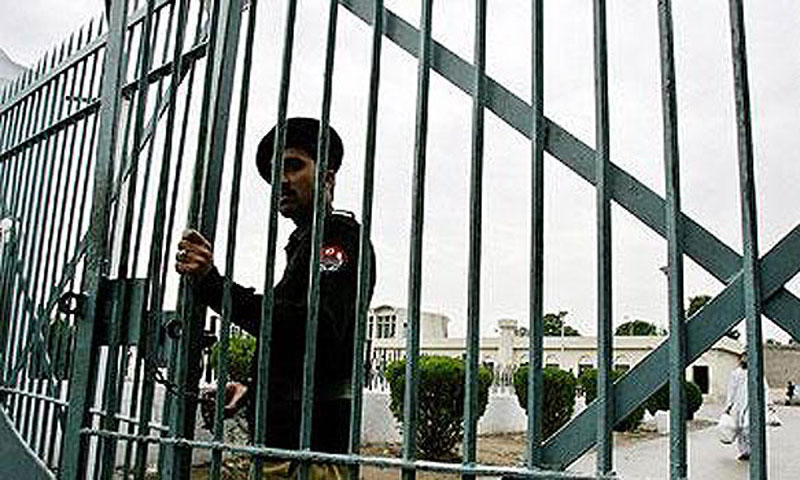

LAHORE: Two inquiries into the recent escape of prisoners in Rawalpindi and Okara point to serious lapses in the movement of dangerous criminals from prisons to courts in Punjab, suggesting measures such as video trials to avoid a recurrence.
Giving a controversial proposal, one of these reports suggests the use of fetters at the police’s discretion. Sources in the Punjab government on Friday said the reports had been sent to the home, law and prosecution departments for consideration of the proposals.
On Dec 2, Farrukh Khokhar, son of Taji Khokhar, escaped when he was being taken to Rawalpindi jail after production in a local court. Farrukh Khokhar was recaptured two days later.
The same day, five armed men opened fire at a prison van, and freed an equal number of prisoners from Gojera and Okara.
They injured three police officials, two of them seriously, and overpowered others, snatching two official rifles.
The prisoners were being transported back to Sahiwal jail after production in courts at Tandlianwala, Jaranwala and Faisalabad. The escaped prisoners are still at large.
The chief minister had ordered inquiries into both the incidents. The committee for the Rawalpindi incident was headed by Punjab Additional IG Investigation Muhammad Amlish and for the Okara incident by Sheikhupura RPO Abu Bakr Khuda Bakhsh.
The Okara committee found lapses in the system, but the Rawalpindi committee detected connivance of police, mentioning the vast influence of Taji Khokhar, who is the brother of former National Assembly deputy speaker Nawaz Khokhar.
RAWALPINDI REPORT: The report says that since Taji Khokhar has connections in the police, he gets officers of his choice posted. He had also tried to escape on Sept 10 last year.
The inquiry holds that the SOPs (standard operation procedures) were not followed while bringing these prisoners to the courts. ‘Private’ persons were allowed to board the police vehicles along with the prisoners.
Farrukh Khokhar and another two prisoners who accompanied him in the van but who did not attempt to flee were not properly handcuffed. Rather, they were made to hold the handcuffs.
Six police officials found involved in the escape have been suspended from service and arrested. Responsibility has also been placed on many senior officials.
The Rawalpindi inquiry report details how outgoing officers routinely do not brief the incoming officers at the time of handing charge at top police positions. Resultantly, those who are new to the job often do not know much important local law and order issues, and dangerous criminals in prison in the area. It proposes the incoming officers should work with the outgoing officers for at least week at the time of handing over of charge.
The report suggests amendments to the relevant laws including the CrPC to ensure jail trial of dangerous criminals, video trial facility in all districts, extension of the judicial remand period to 30 days to avoid frequent movement of under-trial prisoners and revision of the police rules.
The transportation of under-trial prisoners costs Punjab between Rs50 to Rs60 million each month.
Importantly, what the probe committee members have asked for is a revision of distribution of work among police in Rawalpindi district that was notified last in 1989. “Transportation of prisoners to and fro courts should make an integral part of the monthly meetings of the Criminal Justice Coordination Committees headed by district and sessions judges,” they emphasise.
Some other suggestions made by the report are:
• APCs (Armoured Personnel Carriers) should not be used to transport prisoners as no armed policeman can sit on the outside of it as guard. The APC’s use should be limited to protection of the under-trial prisoners.
• Senior police officers hardly ever opt for or accept the research and development assignment happily. These postings should be made more attractive through handsome pay, foreign study tours, and a free hand to the in-charge to select his team from police.
• The handcuffs being used by police were introduced a century ago and have inherent mechanical defects. A prisoner having small wrists can easily free his hand. “Better quality handcuffs which are used internationally should be introduced.”
• Short courses should be held for the operational staff of police to combat new situations
• Trial of all prisoners involved in ATA cases and tried by ATCs should be held inside jails in the face of the security threats and to save resources.
Okara inquiry
The Okara inquiry committee notes that sometimes a murder accused/prisoner, kept in one jail, has to be produced in another district for a minor case. It asks the government to request the judicial authorities to issue a general policy whereby the magistrates/judges should dispose off minor cases of an accused challaned in a major case elsewhere.
The report says: “In case, the criminal cases against the dangerous criminals are scattered in different districts, the police concerned through the prosecution department should file petitions in the high court for consolidation of all these cases in one district to restrict the frequent movement of such criminals. Besides avoiding incidents of escape of the criminals it would also curtail the expenses being incurred on such transportation.”
The committee members are not at all thrilled at the practice where a SP/DSP does not pay due attention to the movement of judicial/under trial prisoners, leaving much of the work to junior officials.
The report proposes amendment to Section 344 of the CrPC, proposing that if there is a reasonable delay in indictment/commencement of trial, the production of the accused be made before a special magistrate as and when appointed in the jail by the government for this purpose. This would minimize pre-trial production of dangerous prisoners in courts.
But then the production of dangerous, hardened and desperate criminals becomes indispensable in many cases. The proposals set out in the report says the prison vans in each district “should be altered so as to provide a shielded and bullet proof sitting area on roof. ... A police guard sitting in this shielded area cannot only command an aerial and all-around view but can also offer better resistance.”
And finally voicing a proposal that may bring rights activities to their toes protesting, this inquiry committee favours fetters to hold down prisoners. “Courts have restrained the use of bar fetters for dangerous convicts in jails, and it is subject to the concurrence of district and sessions judge concerned which is usually delayed or denied. The government may go in judicial review against the rulings so that the discretion of jail authorities for the said purpose can be revived.
“The use of bar fetter is also recommended for dangerous and desperate under trial prisoners for their court production and the police authorities concerned should use this discretion as per PR Rule 175.