0
0

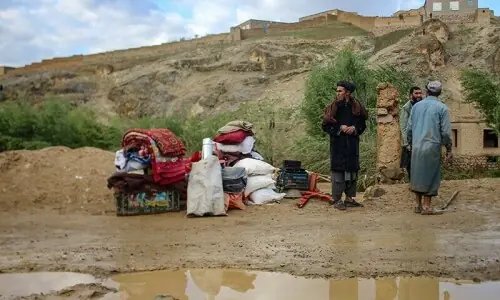
LUGGING three plastic sacks full of clothes, Abu Mohammad and his three daughters pulled back the wrought iron border crossing gate, stepped through it into Turkey and smiled.
As one daughter wept tears of relief, her father recounted their 12-hour journey from Aleppo, through some of the most terrifying and volatile scenes of the Syrian civil war.
“It was miserable,” he said, his eyes haggard from the stress and the relentless two weeks of aerial bombardment that preceded it. “At every checkpoint along the way, we didn’t know who was in charge.
There was The Islamic State of Iraq in Sham [Isis, a name given to the main Al Qaeda group in the north — the Islamic State in Iraq and the Levant], the Free Syria Army, the Islamic Front. It changed every few miles.”
The family had woken early last Friday, sensing the latest outbreak of violence to ravage the north meant a hope of escape. For one week prior, the myriad fighting groups that make up the opposition had been at each other’s throats from Idlib in the north-west, to Raqaa several hundred miles east.
Isis, which had steadily been enforcing a religious tyranny, had been ousted from many of its strongholds and was being surrounded in others.
The fratricidal fighting erupted several weeks before a much-anticipated detente scheduled for Jan 22 in Geneva, adding another layer of complexity to a war that long ago ceased to have two clear-cut protagonists.
“It’s not clear who is winning,” said Abu Mohammad. “It’s not even clear who is fighting.”
As his and other families continued to flee, Syria’s main opposition group was under intense pressure to attend the Geneva conference, which would involve its members sitting at the same table as the regime it has been trying to oust for nearly three years. Fearing the disunity that continues to plague the opposition will give it limited leverage, leading members have said they might not attend.
The Syrian Observatory for Human Rights said that more than 700 people had been killed in the north over the past nine days alone.
Many hundreds more had disappeared. Isis — whose ranks are made up mainly of foreign jihadists who have entered Syria from Turkey and Iraq — has been under attack since Jan 3 in areas where its authority had remained unchallenged since it became a dominant player around eight months ago.
“They have fled from Sarmada,” said Abu Haneyah, another refugee who had just stepped across the border, speaking about his hometown 20 miles south. “For the past few days, we haven’t seen them at all.”
Ten miles across the border in the Syrian village of Atmah — one of the first crossings used by jihadists to enter the country in mid-2012 — gunfire crackled near a refugee camp for internally displaced people.
A local resident on the Turkish side of the border near Atmah, Abu Hussein, said that he had seen hundreds of jihadists pass through on the way to war. Now, he said, some were fleeing back to Turkey.
Several more of Syria’s newest refugees spoke of the destruction Isis had wreaked in the towns and communities it had taken over. All spoke with fear and trepidation about the latest phase of this civil war in which the original opposition formed to face Assad continues to splinter while regime forces claw back gains in other parts of the country.
In the nearby Turkish city of Antakya, an Isis member said that when the fighting between anti-Assad groups finally ends, a more competent opposition force will emerge. “It will be more disciplined, and coherent,” he said. “The opposition will be better for all of this.”
With both the mainstream and Islamist opposition factions now committed to ending the hard-line jihadists as a fighting force — and Isis itself vowing to crush its new foes — mutually assured destruction is another possible outcome.
“You think Geneva is for us anyway?” asked the Isis member. “All that does is trade away what this war has achieved so far. Only Assad can benefit from a conference such as this.”
A civilian refugee put it very differently: “Give us a way out of this. Everything is being destroyed now. No one is winning.”—By arrangement with the Guardian